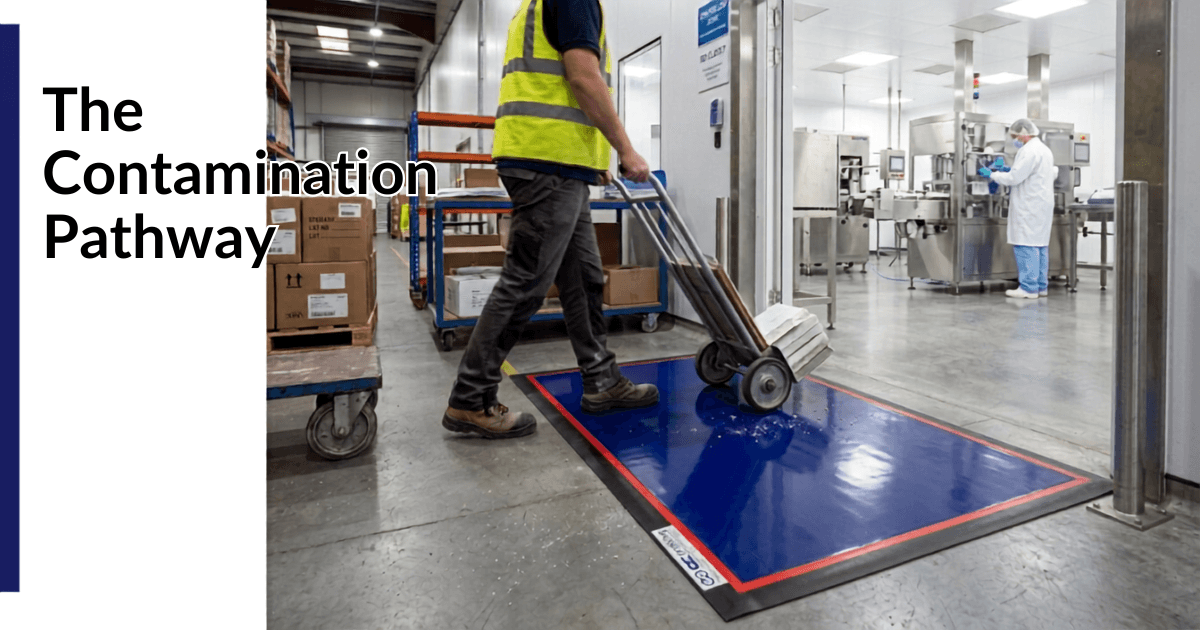
How can pharmaceutical manufacturers prevent contamination during material transfer between the warehouse and cleanroom, and where does that pathway actually break down?
Ask about contamination control in pharmaceutical manufacturing, and you'll get a familiar list back: gowning, HVAC, water systems, raw materials, and cleaning validation. It's not wrong. It's also not where most day-to-day contamination risk actually originates. Materials, people, and equipment don't appear inside a cleanroom fully formed — they arrive from somewhere, and that somewhere is usually a warehouse, a loading bay, or a general production corridor with none of the controls a classified area requires.
Rather than list contamination risks in the abstract, it's more useful to follow the actual physical journey a pallet, a trolley, or a pair of boots makes from an uncontrolled environment into controlled production – and identify exactly where that journey should be interrupted.
Stage One: The Warehouse Environment
Warehouses are functional spaces, not classified ones. Floors accumulate dust from delivery traffic, packaging debris, and general handling. Ambient air isn't filtered to anything like cleanroom standards, and humidity and temperature swing with the season and the loading bay doors. None of this is a defect — a warehouse isn't supposed to perform like a cleanroom. But it does mean that everything sitting in that space, and everything moving through it, is picking up a contamination load as a baseline condition of being there.
This matters because that load doesn't stay behind when the material moves on. It travels with the pallet, the box, and the wheels underneath it.
Stage Two: Material Movement Begins
Once a pallet or container is released for production, it starts a journey most facilities have mapped for traceability and inventory control, but rarely for contamination. Outer packaging carries warehouse dust and fibre. Cardboard sheds cellulose particulate as it flexes and is handled. If the material is destined for a controlled area, someone has usually designed a de-boxing or material airlock (MAL) step somewhere along the route — but the transport method getting the material to that point is often treated as pure logistics, with no contamination consideration at all.
Stage Three: Footwear and Wheel The Pathway Within the Pathway
This is where two separate contamination pathways converge onto the same route. Personnel walking from the warehouse or a general corridor toward the controlled production boundary carry a particulate and microbial load on their footwear, picked up step by step from every surface they've crossed. Wheeled equipment — trolleys, carts, and pallet movers does the same thing at floor level, often carrying more surface-contact area and more contamination than a single set of boots.
Both pathways are frequently governed by different procedures, if they're governed at all. Gowning SOPs address what happens to a person once they're gowning up for entry, not what's already on their shoes when they arrive at the gowning room door. Material handling SOPs address what's inside the box, not what the trolley wheels underneath it have picked up on the way there. Treated separately, each pathway looks manageable. Treated as what they actually are – two contamination vectors converging on the same physical threshold – the combined risk is larger than either procedure alone accounts for.
Stage Four: The Transition Area
Airlocks and gowning rooms exist specifically to manage this convergence, and they're usually well engineered for the risk everyone thinks about first: airborne contamination. Pressure cascade, air change rates, and filtration are validated and monitored. What's less consistently addressed is contact transfer at floor level — the fact that the same square metre of flooring in a transition area gets crossed by shoes and wheels dozens or hundreds of times a shift and that this floor surface is rarely treated as an engineering control in its own right.
A transition area can pass every airflow and particle count check in its validation package and still function as a contamination bottleneck because the metric being monitored (air quality) isn't the mechanism doing the damage (contact transfer at the floor).
Stage Five: Entry to Controlled Production
By the time personnel and materials reach the boundary of controlled production, whatever wasn't intercepted upstream arrives at the point with the least tolerance for it. This is also, not coincidentally, where most facilities finally do have a defined control — a final gowning check, a defined material transfer protocol, and sometimes a dedicated entry mat. The problem isn't that controlled production has no control. It's that this is the last point in the pathway, and a single control positioned at the last possible point has no ability to catch contamination that was already deposited on a trolley wheel three rooms earlier and simply travelled the rest of the way.
Stage Six: Where Interception Actually Belongs
Mapping the pathway this way changes the question from "what controls exist at the cleanroom door" to "at which point in this journey does contamination actually enter the system, and is anything positioned there to intercept it." For footwear and wheels specifically, that point is usually earlier than facilities assume — at the boundary between uncontrolled and semi-controlled space, not just at the final classified-area threshold.
A Practical Way to Evaluate Your Contamination Control Pathway
1. Identify the First Transition Point
What to check: Where do footwear and wheels first cross from an uncontrolled area into a lower-risk controlled zone?
What it reveals: This identifies the earliest practical point where contamination can be intercepted.
2. Check the Existing Control
What to check: Is there a defined contamination control at this transition, or only at the final cleanroom entry?
What it reveals: This shows whether contamination is intercepted progressively or only at the last stage.
3. Evaluate Footwear and Wheeled Traffic
What to check: Does the control address both personnel footwear and wheeled equipment?
What it reveals: This highlights whether trolleys, carts, and pallet movers are bypassing controls designed primarily for personnel.
4. Review Cleaning and Maintenance
What to check: Is the control cleaned and maintained according to traffic volume and defined procedures?
What it reveals: This indicates whether the control can perform consistently throughout its working cycle.
5. Verify Technical Documentation
What to check: Are material, performance, testing, and compatibility data available?
What it reveals: This determines whether the control can be appropriately supported within the facility's Contamination Control Strategy (CCS).
Where a Polymeric Contamination Control Mat Fits Into the Pathway
A polymeric contamination control mat is one way to place a defined, documented interception point exactly where footwear and wheel traffic converge — typically earlier in the pathway than the final cleanroom threshold, at the transition points where warehouse and general corridor traffic first meet controlled or semi-controlled space. CC Matting's Heavy Duty Polymeric Matting has been independently tested against exactly this traffic profile, using a shoe-sole and trolley-wheel challenge methodology on particulate collected from warehouse-floor conditions, with particle and fibre removal efficiency exceeding 90% across the size categories tested. The material also holds Fraunhofer IPA qualification for ISO Class 5 environments and ASTM E595 outgassing screening data, relevant where the matting sits close to or within a controlled zone.
Because the surface is cleaned and reused in place rather than peeled and replaced, it can be positioned at multiple points along the pathway — warehouse-to-corridor, corridor-to-transition-area, transition-area-to-production — without the same waste and disturbance considerations that come with layered peel-off matting at every crossing.
This doesn't replace gowning procedures, airlock design or material transfer protocols. It closes a specific, physical gap in the pathway between them — one that's easy to overlook precisely because it doesn't belong to any single department's SOP.
Frequently Asked Questions
Where should contamination control mats be placed in a pharmaceutical facility?
At every point where footwear or wheeled equipment crosses from an uncontrolled or lower-classification area into a higher one — not only at the final cleanroom entrance. Mapping the full warehouse-to-production route usually reveals more than one crossing point worth controlling.
What's the most overlooked contamination pathway in pharmaceutical manufacturing? The combined footwear-and-wheel pathway between a warehouse or general corridor space and controlled production is frequently under-addressed, because gowning procedures and material handling SOPs tend to treat personnel and equipment movement separately.
Do tacky mats intercept contamination as effectively as reusable matting? Tacky mats can capture particulates when fresh, but adhesion declines with use, and the peel step can disturb trapped particulates. Facilities should evaluate performance across a layer's full working life, not just when new, when comparing options for a given crossing point.
Should wheeled equipment be covered by the same contamination control as personnel? Yes. Trolleys, carts and pallet movers carry a comparable or greater particulate load than footwear and frequently cross the same boundaries, sometimes more often per shift, so a control designed around personnel alone can leave this pathway open.
Does adding an entry mat guarantee GMP compliance at that point? No single control guarantees compliance. An entry mat with supporting documentation can be referenced within a contamination control strategy, but it works alongside gowning, airflow and material transfer controls rather than replacing them.
For facilities mapping their warehouse-to-production contamination pathway, CC Matting's technical data sheet and independent test reports are available on request — get in touch to discuss interception points for your facility layout.