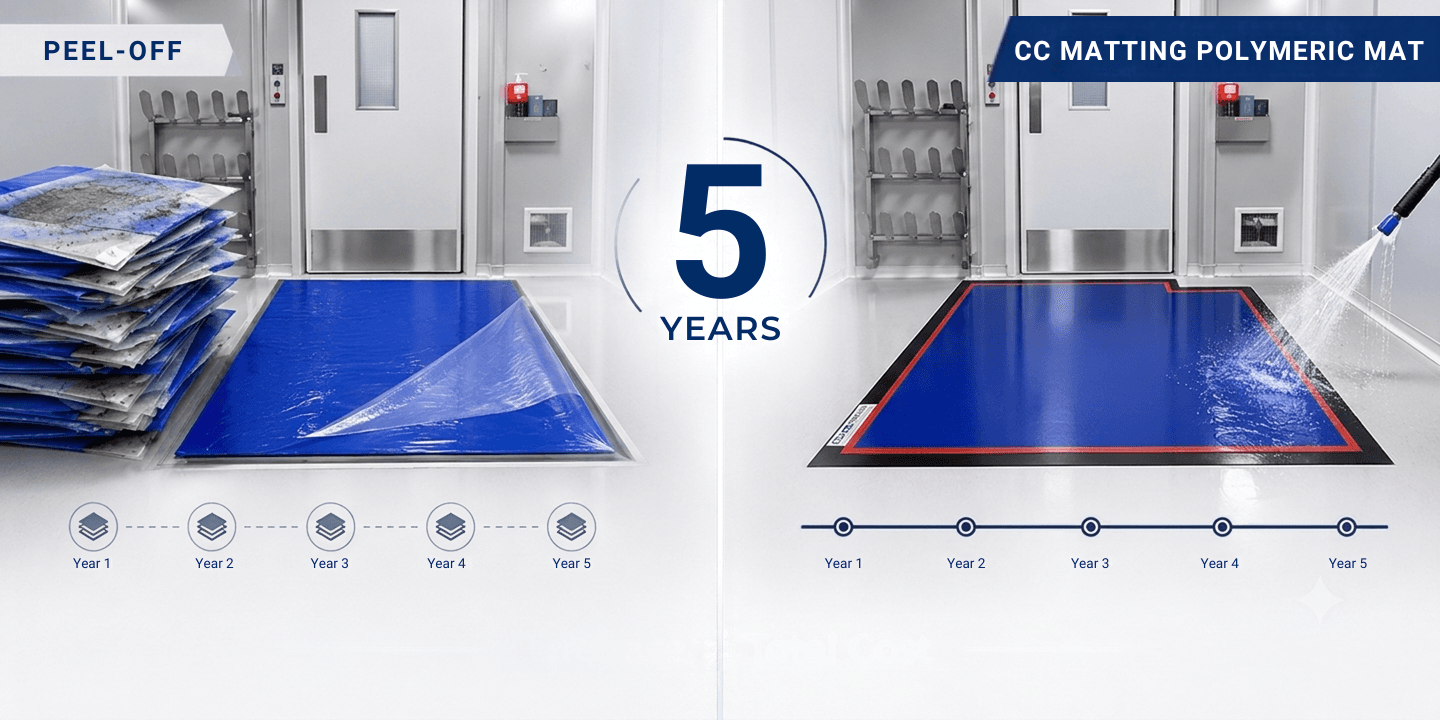
Quick answer: Tacky mats are a recurring consumable: adhesive layers are peeled and discarded all year. Polymeric contamination control matting is an upfront installation that is cleaned in
place and replaced at the end of a 3–5 year working life. Which costs less depends on your peel frequency, entrance count and cleaning routine, so model both with your own figures.
What are tacky mats (sticky mats)?
Tacky mats, also called sticky mats, are pads of stacked adhesive-coated film placed at doorways. Footwear and wheels press onto the top sheet, which holds loose particles. When that sheet is loaded with debris, it is peeled off and discarded to expose the next one.
Because they arrive as a line on a consumables order, few sites add up what they cost over the life of a facility. The figure that drives that cost is not the pad price. It is how often a layer is peeled, which is set by your SOP, your traffic and how quickly each sheet loads.
What is polymeric contamination control matting?
Polymeric contamination control matting is a reusable floor surface installed where uncontrolled and controlled zones meet. Instead of discarding a layer, the surface is cleaned in place on a schedule set by your contamination control SOP.
CC Matting's heavy-duty polymeric matting is supplied in 2.0 m widths with no fixed length limit, so it can cover the full stride length or trolley run of an entrance rather than a standard pad footprint. It is static dissipative, has an integrated antimicrobial additive, and has a specified working life of 3–5 years. CC Matting installs in Ireland and the UK and distributes worldwide.
Polymeric matting vs tacky mats: side-by-side comparison
Each attribute below compares the two approaches directly.
Capture method
• Tacky mats: Adhesive film holds particles until the layer is peeled away.
• Polymeric matting: A reusable polymer surface retains particles between cleans.
Contact area
• Tacky mats: Fixed pad footprint.
• Polymeric matting: Supplied 2.0 m wide with no fixed length limit, so it can be sized to the stride length or trolley run.
Waste generated
• Tacky mats: Peeled sheets, pad backing and packaging, generated continuously.
• Polymeric matting: Used cleaning wipes during service; the mat itself at end of life.
Replacement frequency
• Tacky mats: Every peel event; pads restocked as they are consumed.
• Polymeric matting: Once, at the end of the working life.
Cleaning
• Tacky mats: Not cleaned; the loaded layer is removed instead.
• Polymeric matting: Cleaned in place at the frequency your SOP sets. Avoid acetones and abrasive agents.
Working life
• Tacky mats: One adhesive layer at a time.
• Polymeric matting: 3–5 years, with a full two-year warranty.
ESD properties
• Tacky mats: Varies by product; check supplier data.
• Polymeric matting: Static dissipative, with a surface resistivity of 1×10¹⁰ Ω/sq.
Independent testing
• Tacky mats: Varies by product; ask the supplier what data exists.
• Polymeric matting: Third-party tested for particle removal, particle emission, surface resistivity, slip resistance and antimicrobial activity, documented in the Quality & Efficacy Manual.
How to calculate total cost of ownership
A defensible business case compares both approaches over the same period using your own quotes. No market prices are assumed here; enter your contracted figures.
Inputs to gather
• E: number of matted entrances
• P: peels per entrance per shift
• S: shifts per day
• D: operating days per year
• C: cost per adhesive layer (pad price ÷ layers per pad)
• X: disposal cost per layer
• I: installed cost of polymeric matting
• K: annual cleaning cost (labour plus wipes and cleaning agent)
• W: working life in years (use 3 for a prudent case)
Step 1: Annual tacky mat cost
Layers per year = E × P × S × D
Annual tacky mat cost = Layers per year × (C + X)
Worked volume: a site with 4 entrances, peeling once per shift on 3 shifts, 250 days a year, uses 4 × 1 × 3 × 250 = 3,000 layers a year, or 9,000 over three years. On a 24/7, 365-day operation the same site uses 4,380 layers a year.
Step 2: Annual polymeric matting cost
Annual polymeric cost = (I ÷ W) + K
Step 3: Break-even
Break-even (months) = I ÷ [(Annual tacky cost − K) ÷ 12]
If break-even falls inside the two-year warranty, the case is robust. If it only works at five years, it depends heavily on your assumptions. Two further checks strengthen the model:
• Use your actual peel rate, not the written SOP rate. The two often differ, and the actual rate sets spend.
• Add the costs around the pad: ordering, goods-in, buffer storage near controlled areas, peeling labour and stock-out risk.
When tacky mats still make sense
A peel-off format can remain the practical choice for short-term areas such as shutdown projects, very low-traffic doors where annual consumption is minimal, and leased spaces where a permanent installation is not practical.
Reusable vs disposable: waste and disposal
In the worked example, 9,000 peeled layers over three years is a physical waste stream that needs bagging and removal, with pad backings and packaging on top. Adhesive-coated film is generally not a straightforward recycling stream, so confirm options with your waste contractor.
With washable contamination control mats, ongoing waste is mainly used cleaning wipes. At end of life, CC Matting's safety data sheet recommends recycling wherever possible, otherwise landfill or incineration in line with local regulations. For sites with single-use plastic reduction targets, fewer disposal events per entrance can be part of the case in its own right.
Test evidence
CC Matting's polymeric matting was assessed in an independent particle-removal study using contaminated footwear and trolley wheels.
Particle removal: footwear
• Particles above 5 µm: 91.8% removal
• Particles above 100 µm: 100% removal
• Fibres above 100 µm: 92.0% removal
Particle removal: trolley wheels
• Particles above 5 µm: 90.1% removal
• Particles above 100 µm: 100% removal
• Fibres above 100 µm: 100% removal
These results apply only to the materials, environment and method used in that study and do not reflect performance in every application.
Other
documented properties
• Particle emission suitable for ISO Class 5 environments
• Static dissipative surface resistivity of 1×10¹⁰ Ω/sq
• Slip resistance: mean 65 PTV dry and 57 PTV wet, both in the low slip risk range
• Integrated antimicrobial additive, independently tested for antimicrobial activity
EU GMP Annex 1 (2022) requires sterile manufacturers to maintain a documented contamination control strategy. Matting is one element within it; no mat on its own makes a facility compliant, and switching from tacky mats normally goes through change control.
Are washable sticky mats the same thing?
Not necessarily. Some products marketed as washable or reusable sticky mats keep a tacky surface that is rinsed to restore it. The names overlap, so compare products on substance rather than labels:
• How the surface captures and holds particles
• How it is cleaned, how often, and which agents it tolerates
• Specified working life and warranty
• ESD properties and slip resistance
• What independent test data exists, and under what conditions
FAQs
- Are polymeric mats cheaper than tacky mats over time?
It depends on your site. High-traffic entrances with frequent peeling build consumable spend fastest, and that is where reusable matting is most likely to pay back. Very low-traffic or temporary areas may never recover the upfront cost. Calculate break-even using your own peel frequency, layer cost, installed cost and cleaning cost.
- Are tacky mats and sticky mats the same thing?
Yes. Both terms describe peel-off adhesive mats made from stacked film layers. When the top layer is loaded with debris, it is peeled away to expose a fresh sheet. Products sold as washable sticky mats are a separate type and should be assessed on their own data.
- How long does polymeric contamination control matting last?
CC Matting's heavy-duty polymeric matting has a specified working life of 3–5 years, with a full two-year warranty. Actual life depends on traffic and care. For budgeting, model at three years so the business case does not rely on maximum service life.
- How is polymeric contamination control matting cleaned?
It is cleaned in place at the frequency set by your contamination control SOP. Before particle-removal testing, the mat was cleaned with 70% isopropyl alcohol and lint-free cleanroom wipers. The product's safety data sheet lists acetones and abrasive agents as materials to avoid.
- What particle removal has been tested?
In an independent study, CC Matting's polymeric matting removed 91.8% of particles above 5 µm from footwear and 90.1% from trolley wheels. Particles above 100 µm were 100% removed, and fibres above 100 µm 92.0% (footwear) and 100% (trolley wheels). Results apply to that study's materials and conditions.
Next step
Start with your entrance count and actual peel frequency, then compare that consumption against a quoted installation. Request the CC Matting Quality & Efficacy Manual to support QA review, or share your entrance count and current tacky mat replacement frequency with the CC Matting team to
discuss sizing for your entrances and trolley routes.