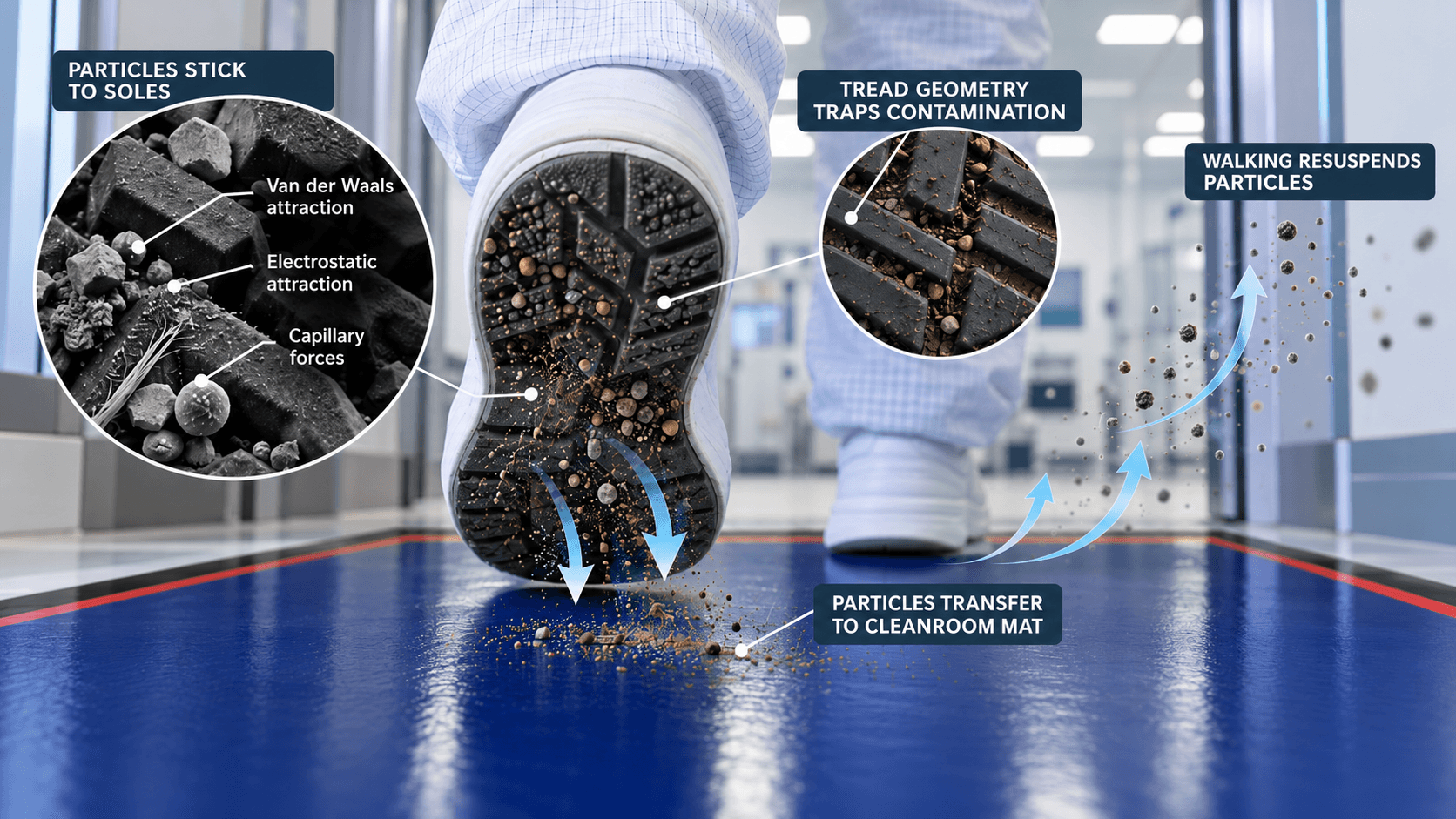
A shoe sole is never a passive surface. Every step presses it into the floor, picks up fresh particles and releases some of what it already carries: into the air, onto the next tile, or into the next room. For footwear contamination control, understanding that exchange matters more than any single product decision.
Why particles stick to shoe soles
Three forces hold a particle to a sole: van der Waals attraction between surfaces in close contact, electrostatic attraction from triboelectric charging as soles repeatedly touch and leave the floor, and capillary forces where humidity or cleaning residue forms a liquid bridge.
Scale is decisive. Adhesion falls roughly with particle diameter, while removal forces such as gravity and airflow depend on mass, which falls with diameter cubed. Fine particles are held far more firmly than their size suggests, so a sole that looks clean can carry a heavy fine-particle load, and stamping or wiping mainly removes coarse debris. In electronics areas the same static charge is also an ESD risk, which is why the static behaviour of contamination control flooring and cleanroom mats belongs in footwear risk assessments.
Tread geometry: where contamination hides
Tread is designed for grip, not cleanliness. Grooves and lugs create pockets where debris is packed out of reach of any flat surface; a mat can only clean the raised faces that touch it. As the sole flexes, packed material fractures and releases, often metres inside the area it was meant to stay out of. Dedicated footwear and overshoes shrink this reservoir but cannot prevent transfer at the point they are put on.
Resuspension: how walking lifts particles back into the air
Each footfall acts as a small pump. As the sole flattens, trapped air is forced out sideways at speed; as it lifts, air rushes back. These jets, with the shock of contact, detach particles from floor and sole and lift them into room air. Indoor resuspension research generally finds the effect increases with particle size across the micron range, with walking speed and with floor loading. A floor kept clean at the entry point shrinks the reservoir every later footstep can disturb.
Why contact steps matter
Transfer from sole to mat is partial on every contact: one step brings only part of the sole into full contact, at uneven pressure, for a fraction of a second. Removal is cumulative, so each additional full contact strips a further share of what remains. For cleanroom entrance mats, that means:
• Size to stride, so each foot lands several times before the controlled side.
• Place where traffic funnels, such as airlocks and change-room exits.
• Allow length for wheels to make repeated full rotations.
• Clean on a defined frequency, because a loaded surface captures less.
In a 2026 walk-off study by CPC Laboratories, three steps per shoe onto CCM polymeric contamination control matting removed on average 91.8% of particles over 5 µm, 100% of particles over 100 µm and 92.0% of fibres over 100 µm from shoes loaded with warehouse floor dirt. Trolley wheels rolled across 90 cm of mat showed 90.1%, 100% and 100% respectively. The laboratory notes that results apply to the method tested, not every application.
Tacky mats vs reusable cleanroom matting
Tacky mats, or sticky mats, address the same adhesion physics with peel-off adhesive sheets. Washable contamination control mats made from polymer are the main sticky mat alternative.