An auditor rarely asks whether there is a mat at your cleanroom entrance. The harder question is: how do you know it is clean, and where is that written down?
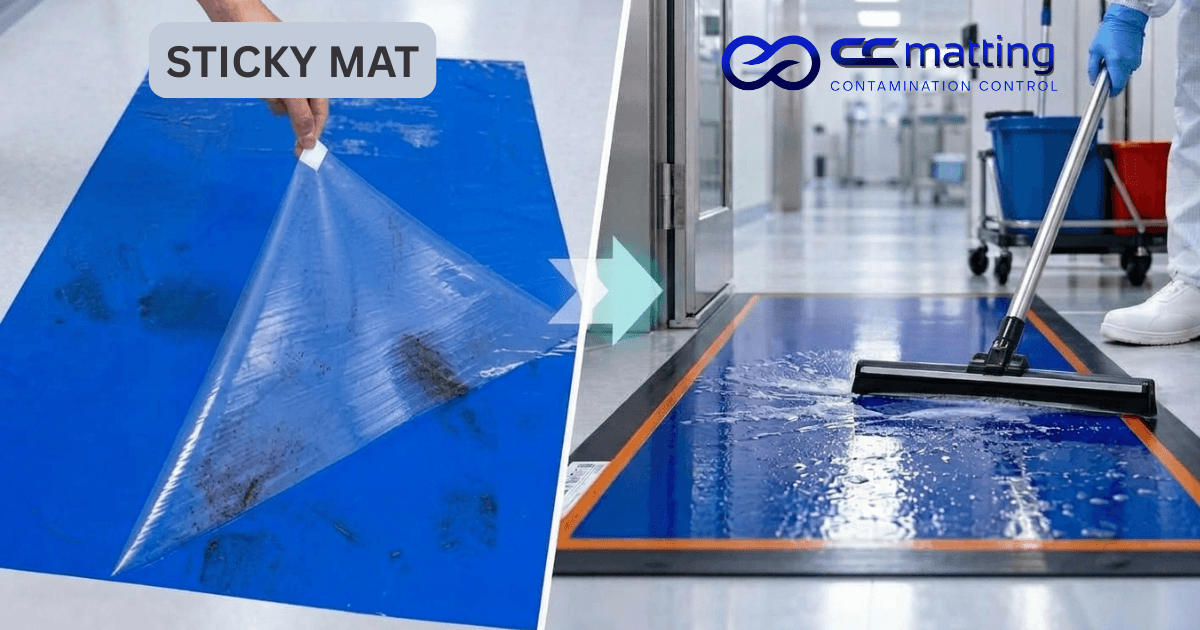
The question changes when a facility replaces peel-off tacky mats with washable contamination control mats. A tacky mat is a consumable; the record shows a sheet was changed. A polymeric contamination control mat stays in place for years, so it becomes a surface to clean, disinfect and monitor like any other floor. This guide covers both: cleaning the mat, and proving the cleaning works.
Why a washable mat belongs inside your cleaning programme
Once a mat is no longer disposable, control shifts from replacement to cleaning. EU GMP Annex 1 (2022) expects sterile manufacturers to run a documented contamination control strategy that covers cleaning, disinfection and monitoring. It also treats cleaning and disinfection as separate steps: surface contamination must be removed first, or the disinfectant cannot work properly.
A mat at a zone interface therefore belongs inside your existing programme, not beside it. Medical device and semiconductor sites outside Annex 1 face the same logic through their own quality systems.
Peel-Off Tacky Mat vs Washable Polymeric Mat
1. How the mat is restored
Peel-off tacky mat: The used top sheet is peeled off to expose a fresh adhesive layer.
Washable polymeric mat: The surface is cleaned and disinfected without removing the mat.
2. What the SOP records
Peel-off tacky mat: Sheet replacement, time and operator.
Washable polymeric mat: Cleaning agent, contact time, operator and date.
3. What verification checks
Peel-off tacky mat: Whether a fresh adhesive layer is exposed.
Washable polymeric mat: Whether the surface is demonstrably clean.
4. What leaves the room
Peel-off tacky mat: Used adhesive sheets.
Washable polymeric mat: Used wipes and cleaning solution.
Cleaning a polymeric mat: what the material allows
Start with what the material tolerates. For CC Matting’s polymeric contamination control matting:
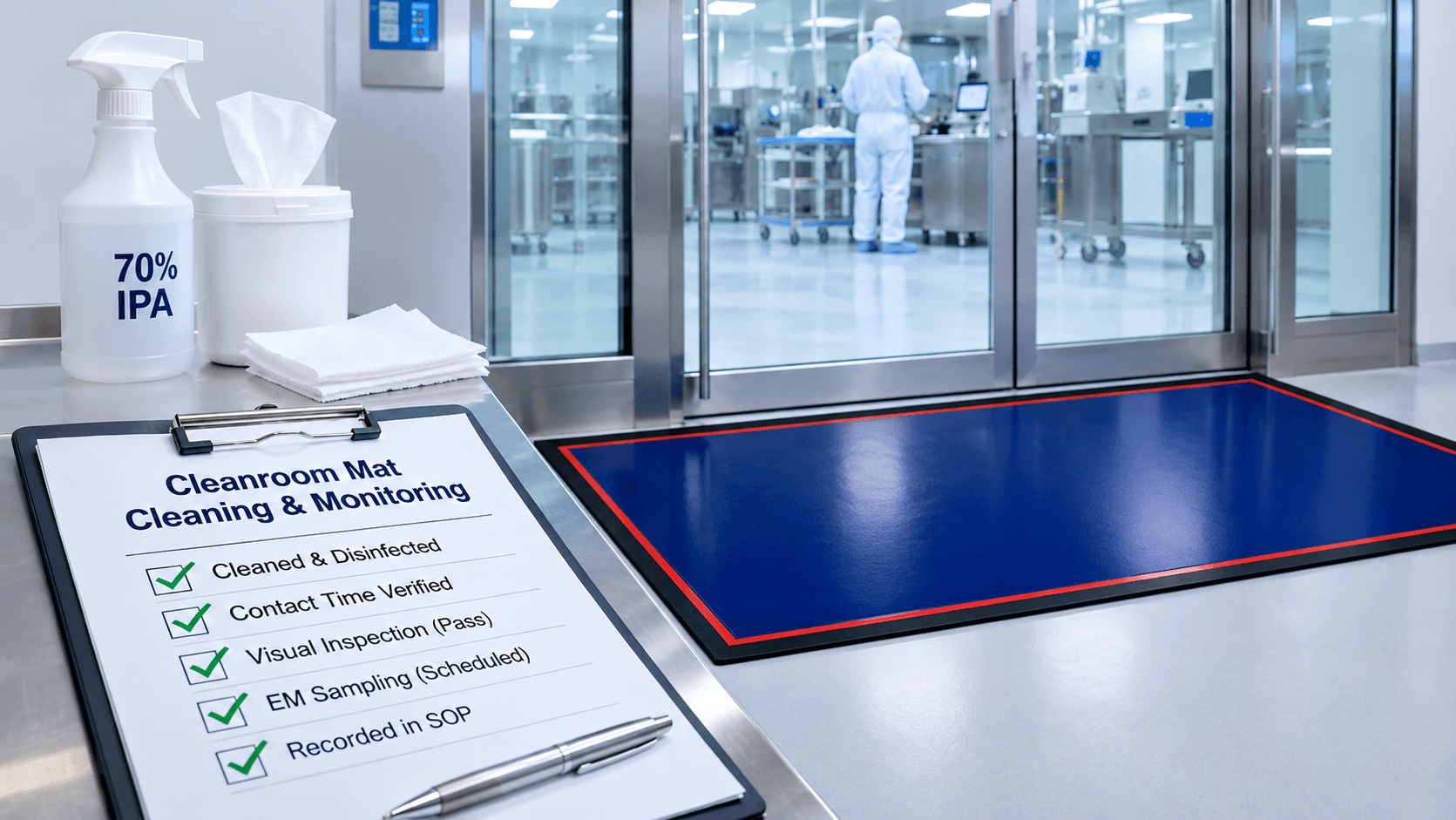
• 70% isopropyl alcohol applied with lint-free cleanroom wipers is a suitable wipe-down.
• Avoid acetone and abrasive agents, including scouring pads and abrasive powders.
• Keep cleaning solutions within the 0–80°C operating range of the material.
• Wet slip resistance stays low-risk: 57 PTV wet and 65 PTV dry, which matters while the surface is still damp after cleaning.
The mat’s integrated antimicrobial additive is not a substitute for cleaning or disinfection, and your SOP should not treat it as one.
Annex 1 expects more than one type of disinfectant where disinfectants are used. Before adding a sporicide or other agent to your rotation, confirm compatibility with CC Matting first.
A practical cleaning sequence
1. Remove loose debris by cleanroom vacuum or damp wipe; dry sweeping re-suspends particles.
2. Clean with 70% IPA or another confirmed-compatible agent, working from the clean side of the mat towards the dirty side.
3. Apply the disinfectant and respect its validated contact time.
4. Allow the surface to dry before reopening it to traffic, unless your risk assessment says otherwise.
5. Record the agent, lot number, contact time, operator and date.
Frequency should come from your risk assessment and trended monitoring data, not a generic figure.
Verifying it worked: three checks auditors understand
Visual inspection at every clean
Check for residue film, soiling, lifted edges and damage, and record pass or fail. A cut or worn area is harder to clean than an intact surface.
Surface microbial sampling
Add the mat to your environmental monitoring plan as a named sampling location. Contact plates suit flat mat surfaces; use media containing neutralisers so disinfectant residue does not suppress growth. During cleaning validation, take samples before and after disinfection to show the process reduces bioburden in practice.
Particle counts near the transition point
Trend non-viable particle counts close to the cleanroom entrance mats, both at rest and in operation. A rising trend does not prove the mat is at fault, since gowning and airflow also contribute, but it shows where to look first, and footwear contamination control is usually part of the answer.
What the SOP should contain
A defensible procedure names approved agents and contact times, the cleaning frequency and its rationale, the mat as an EM location with alert and action limits, and its link to your contamination control strategy.
It should also define replacement by condition, not date. CC Matting’s mats have an expected lifetime of three to five years, so inspection criteria for wear and damage are more useful than a fixed calendar. The material is rated suitable for ISO Class 5 environments, but no mat makes a facility compliant on its own; documented cleaning and trended data are what demonstrate control.
Frequently asked questions
How do you clean a washable contamination control mat?
Remove loose debris, clean the surface with 70% isopropyl alcohol or another agent confirmed as compatible, apply your disinfectant for its validated contact time, then let it dry. Record each clean. Avoid acetone and abrasive pads, which can damage polymeric surfaces.
How do you clean a sticky mat?
Tacky or sticky mats are not cleaned. The loaded top adhesive sheet is peeled off and discarded to expose a fresh layer. Washable mats work differently: the same surface is cleaned and disinfected in place, so verification focuses on cleanliness rather than sheet changes.
How often should cleanroom mats be cleaned?
There is no universal frequency. Base it on area classification, traffic and risk assessment, then adjust using monitoring trends. A busy uncontrolled-to-controlled interface usually needs more frequent cleaning than a low-traffic corridor.
How do you prove a contamination control mat is clean for an audit?
Combine three types of evidence: signed cleaning records, surface microbial results from contact plates taken on the mat, and trended particle counts near the entrance. Pre- and post-disinfection samples during cleaning validation show the procedure works under real conditions.
Does an antimicrobial mat need disinfecting?
Yes. An integrated antimicrobial additive does not remove soil or replace a validated cleaning and disinfection programme. Clean, disinfect and monitor the mat like any other floor surface.
Next step
If you are drafting or revising a mat cleaning SOP, the CC Matting team can share the product’s technical data sheet and cleaning compatibility information. Contact CC Matting via ccmatting.ie to discuss your entrance layout and cleaning regime.