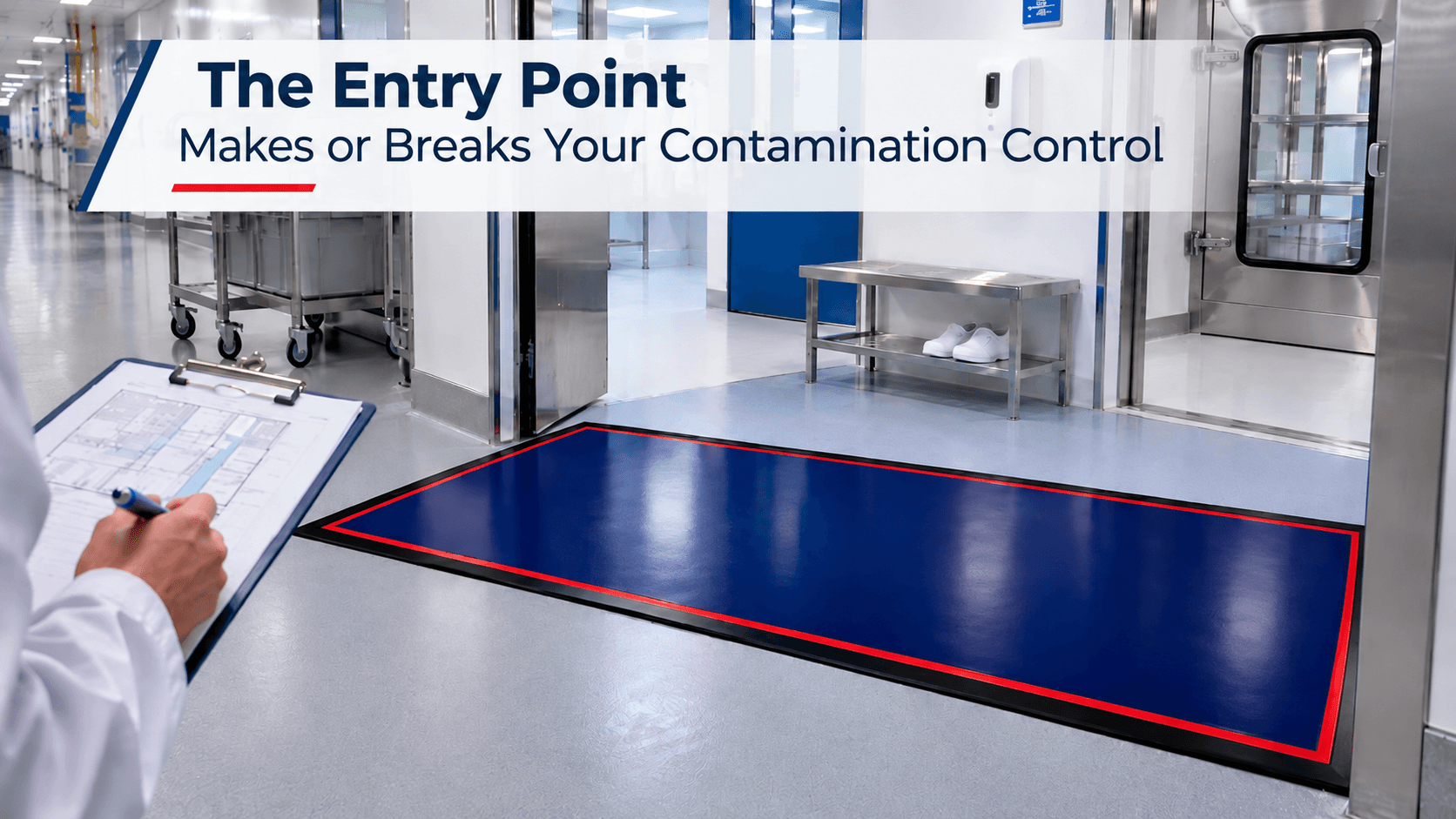
Writing the Floor-Level and Entry-Point Section of Your Contamination Control Strategy: Where Matting Fits and Where It Doesn't
Many contamination control strategy (CCS) documents give HVAC and gowning several pages, then cover the floor in one line: "contamination control mats are installed at entrances." That tells a reviewer nothing about risk, reasoning or verification.
The revised EU GMP Annex 1 expects a CCS to show how controls work together, and the floor is where several meet. Here is how to write that section as risk reasoning rather than a purchasing note.
Start With the Pathway, Not the Product
Floor-borne contamination travels on three main carriers:
• Footwear, which collects particles and microorganisms in corridors, warehouses and locker areas.
• Wheels on trolleys, pallet trucks and waste carts, which pick up debris over long distances and redeposit it with every rotation.
• Items set down on the floor during material transfer, such as boxes, totes and equipment.
Open the section by naming these carriers and their routes through your site, so every later control traces back to a defined risk.
Map Every Entry Point Before Assigning Controls
List each place where floor traffic crosses from a lower to a higher cleanliness zone:
• Personnel entry from general areas into the controlled suite
• Change rooms and airlocks between grades
• Material and equipment airlocks, including trolley transfer points
• Warehouse-to-dispensing and warehouse-to-production interfaces
• Waste exit routes, which often run against the clean flow
• Maintenance and contractor access, the route most often left out
Record traffic type, frequency, adjacent grades and whether flow is one-way. Annex 1 says separate change rooms for entering and leaving should be used where the CCS indicates high contamination risk, so show that judgement here.
Describe Controls as a Sequence, Not a List
Walk through entry in the order a person or trolley experiences it: footwear change or overshoes, floor-level particle capture, hand hygiene, gowning, airlock and pressure cascade, then routine floor cleaning and disinfection.
State what each layer does and what happens if it fails, so no single measure, matting included, is presented as the barrier.
Where Contamination Control Matting Fits
A contamination control mat belongs where footwear or wheels move from a dirtier floor to a cleaner one, before gowning or transfer is complete: suite entrances, change-room approaches, material airlocks and warehouse interfaces. Size it to stride length and wheel circumference so contact is repeated, not incidental.
Justify the choice by function, not brand. For polymeric contamination control mats, relevant points are:
• Clean-in-place surface. It is cleaned with the floor routine rather than peeled and discarded, the main operational difference from a tacky mat.
• ISO Class 5-suitable, low-outgassing material.
• Static-dissipative surface, relevant where electrostatic discharge is a concern.
• Slip resistance. Mean pendulum test values of 65 dry and 57 wet both sit in the low slip-risk range, which matters on floors that are wet-cleaned.
• Integrated silver-based antimicrobial additive within the material.
• Service life of 3 to 5 years, so record replacement triggers rather than consumption rates.
Where Matting Does Not Fit
Stating limits makes the section more credible:
• Not a substitute for footwear change, gowning or airlocks, and never a reason to relax them.
• Not inside Grade A. In Grade B, Annex 1 expects sterilised footwear, so floor-level capture belongs upstream of that step.
• Not a fix for design flaws such as crossing personnel and material flows or a missing airlock.
• Not where it cannot be cleaned or creates a trip or door-clearance problem.
• Not a compliance guarantee. It contributes to a risk-based strategy.
Make the Section Verifiable
Close with maintenance and checks: cleaning frequency and agent (avoid acetones and abrasives), inspection criteria, replacement triggers, downstream environmental monitoring points and how floor-related excursions are trended. Annex 1 expects CCS effectiveness to form part of periodic management review, so name where this data feeds in.
Example wording
"Personnel and trolley traffic entering the Grade C suite from the general corridor pass over a polymeric contamination control mat before the change room. The mat reduces floor-borne particulate carried forward on footwear and wheels. It supplements, and does not replace, the footwear change and gowning in the change room. Cleaning, inspection and replacement are defined in SOP-XXX, and downstream floor EM results are trended quarterly."
Frequently Asked Questions
Does EU GMP Annex 1 require contamination control mats?
No. Annex 1 does not mandate any specific mat. It expects controls to be risk-justified within the contamination control strategy. If you use matting, explain the pathway it addresses, its place in the entry sequence and how it is monitored.
Where should cleanroom entrance mats be placed?
At transitions from a less clean floor to a cleaner one, such as suite entrances, change-room approaches and material airlocks. Place them before gowning or transfer is complete, sized for repeated footwear and wheel contact.
Is a polymeric mat an acceptable tacky mat alternative in a CCS?
It can be, provided the CCS explains its function, cleaning regime and replacement triggers. Because it is cleaned in place rather than peeled, the CCS describes a cleaning procedure instead of a layer-change frequency.
Should contamination control matting be used inside Grade B areas?
Generally it is better placed upstream. Annex 1 expects sterilised footwear in Grade B, so floor-level capture is most useful in the transitions leading to it. Any use closer to aseptic areas should be risk-assessed and justified.
How often should the floor-level section of a CCS be reviewed?
Review it with the wider CCS at periodic management review, and whenever layouts, traffic patterns, cleaning agents or monitoring trends change. Floor-related EM excursions or new entry routes should trigger an earlier update.
Next Step
Mapping entry points for a CCS revision? Our team can talk through placement, sizing and cleaning for polymeric contamination control mats at your transitions. CC Matting installs across Ireland and the UK and supplies worldwide. Review the specifications or get in touch via ccmatting.ie.