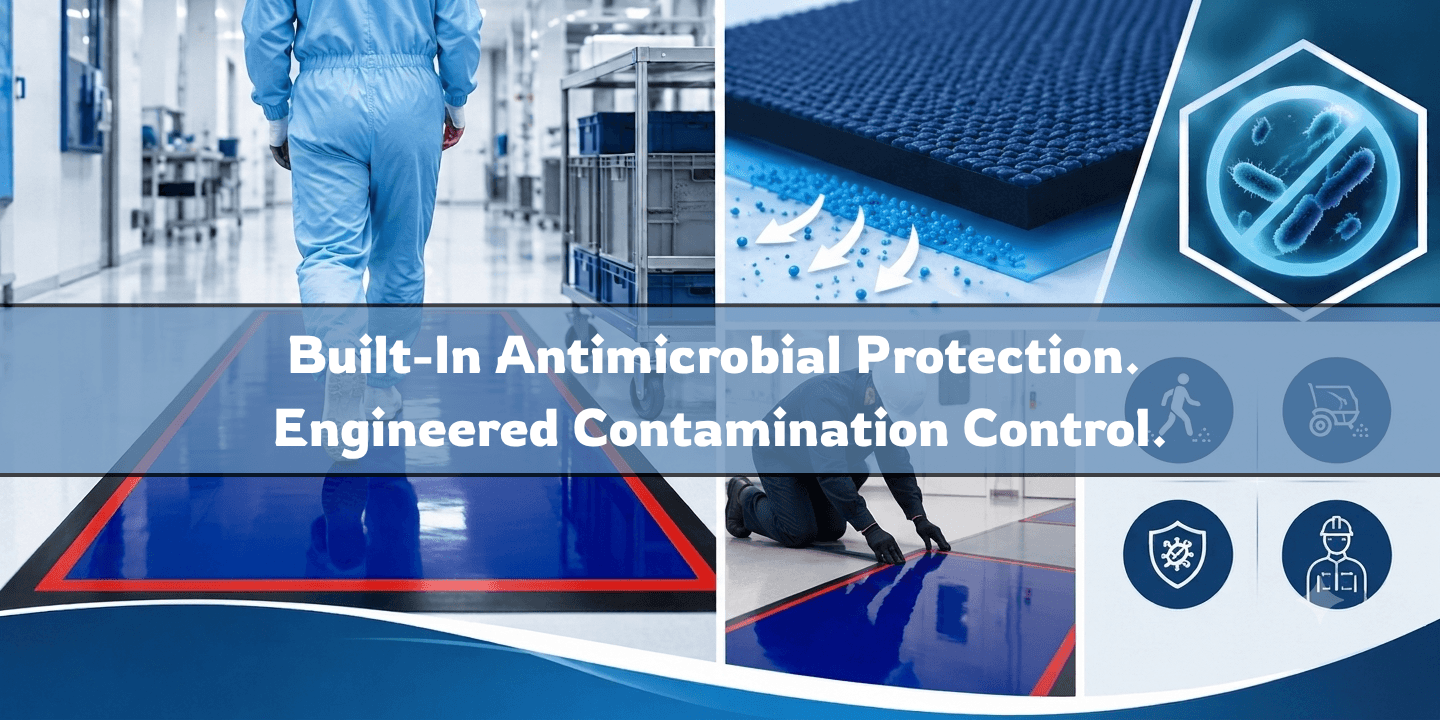
Contamination control starts with the movement of people and equipment
Cleanrooms and controlled environments are designed to manage what enters, moves through and leaves a critical space. Considerable attention is given to air filtration, garments, cleaning regimes, material transfer and operating procedures, yet the floor remains a constant point of interaction. Every person, trolley and wheeled item moving between zones has the potential to carry particulates with it.
This makes floor-level contamination control a practical design question. The appropriate solution depends on where it will be installed, the traffic it must withstand, how it will be cleaned and how it fits within the facility's wider contamination-control strategy.
A facility-specific approach
CC Matting supplies polymeric contamination-control solutions for pharmaceutical, medical-device, laboratory, semiconductor, data-centre and other demanding environments. Rather than treating matting as a generic accessory, the company considers the operating conditions of the installation.
Pedestrian traffic, trolley movements, pallet trucks, cleanroom classifications, available floor space and transition points can all influence the required configuration. CC Matting's heavy-duty system can be produced to suit the installation area, helping facilities place the matting where repeated footfalls or wheel rotations can support particle collection.
How polymeric contamination-control matting works
CC Matting describes its material as a polymeric compound with a naturally tacky, slightly conforming surface. When footwear or wheels pass across the mat, close surface contact helps the material attract and retain particulates until they are removed during cleaning.
This is different from a disposable peel-off mat, where saturated adhesive layers are removed and discarded. A reusable polymeric system is cleaned to remove accumulated contamination and restore its collection surface. The choice between systems should always be based on verified performance, facility procedures, traffic and total operational requirements.
Designed for demanding traffic
Critical environments do not all experience the same loading. Some transition points primarily serve pedestrians, while others must accommodate trolleys, powered equipment or heavier wheeled traffic. This can place substantial mechanical demands on the installed material.
CC Matting positions its heavy-duty polymeric matting for these demanding settings. Its campaign story should therefore focus on the complete engineered proposition: material formulation, traffic capability, custom sizing, edge treatment, professional installation and ongoing cleaning. Each published technical figure should be supported by the relevant CC Matting documentation.
Why professional installation matters
The effectiveness of an installed system depends on more than the material alone. Coverage, positioning, substrate condition, transitions and edge finishing all influence how the installation performs in day-to-day use.
CC Matting states that installations are completed by its own trained personnel. The mat is adhered to the floor, finished with diminishing strips and sealed around its perimeter. This approach is intended to produce a stable, cleanable transition suited to the facility layout while reducing potential trip points and inaccessible edges.
Built-in antimicrobial product protection
CC Matting incorporates Biomaster antimicrobial additive technology into the polymer composition of treated products. Because the technology is introduced during manufacture, it becomes part of the treated material rather than an after-market coating or temporary surface application.
Biomaster helps inhibit microbial growth on the treated mat surface. This supports the protection of the product itself and complements routine cleaning and maintenance. It is important to distinguish this material-protection function from the physical capture of particles: the polymeric mat performs the particulate-retention role, while Biomaster provides antimicrobial protection for the treated product.
Supporting the realities of critical industries
In pharmaceutical and medical-device production, contamination-control measures form part of a much wider quality and operational framework. In semiconductor and data-centre environments, fine particulates and electrostatic considerations can create different priorities. Laboratories, aerospace facilities and advanced manufacturing sites introduce further variations in traffic, layout and process sensitivity.
CC Matting's strongest proposition is therefore not a single universal claim. It is the ability to discuss the application, recommend an appropriate matting configuration and support the installation around the customer's actual facility.
Cleaning, maintenance and service life
Reusable matting must be supported by a clear cleaning procedure. Contaminants collected on the surface need to be removed at suitable intervals so the mat can continue to perform its intended role. Cleaning frequency should reflect traffic, contamination loading and the facility's own standard operating procedures.
CC Matting communicates a multi-year service-life proposition for its polymeric systems. Before publication, the precise life expectancy, warranty and recyclability statements should be confirmed against the applicable product specification and the conditions under which the mat will be installed and maintained.
Experience developed around critical industries
CC Matting has developed a particularly relevant position within Ireland, home to extensive pharmaceutical, medical-device, technology and advanced-manufacturing activity. These environments provide a strong foundation for an application-led story based on polymeric materials, critical transition points and professionally installed contamination-control systems.
By keeping the focus on real facility requirements, CC Matting can demonstrate how its material, installation and maintenance proposition responds to the needs of demanding controlled environments.
A complete material and installation story
Effective contamination control is rarely delivered by one feature in isolation. Product selection, coverage, traffic, installation, cleaning and operating procedures must work together.
CC Matting brings these considerations into one engineered proposition. Its polymeric matting is designed to retain particulates carried by feet and wheels; its project approach adapts the installation to the facility; and Biomaster provides built-in antimicrobial product protection for the treated surface.
For organisations reviewing floor-level contamination control, the next step is not simply to compare headline percentages. It is to define the critical transition points, understand the traffic and cleaning requirements, review the supporting technical evidence and specify a solution suited to the environment.
FAQ
- How is Biomaster used in CC Matting products?
Biomaster antimicrobial technology is incorporated into the polymer composition of treated CC Matting products during manufacture, providing built-in protection against microbial growth on the treated mat surface.
- Does Biomaster remove particles from footwear or wheels?
No. Particulate collection is a physical property of the polymeric mat. Biomaster provides antimicrobial product protection for the treated material.
- Does antimicrobial matting replace cleaning?
No. Biomaster complements the recommended cleaning and maintenance procedure. It does not make the mat or facility sterile and is not a substitute for hygiene, disinfection or contamination-control protocols.
- Discuss your facility with CC Matting (Call-to-Action)
-
To explore CC Matting's heavy-duty, portable and application-specific contamination-control solutions, contact the CC Matting team to discuss your facility, layout and traffic requirements.