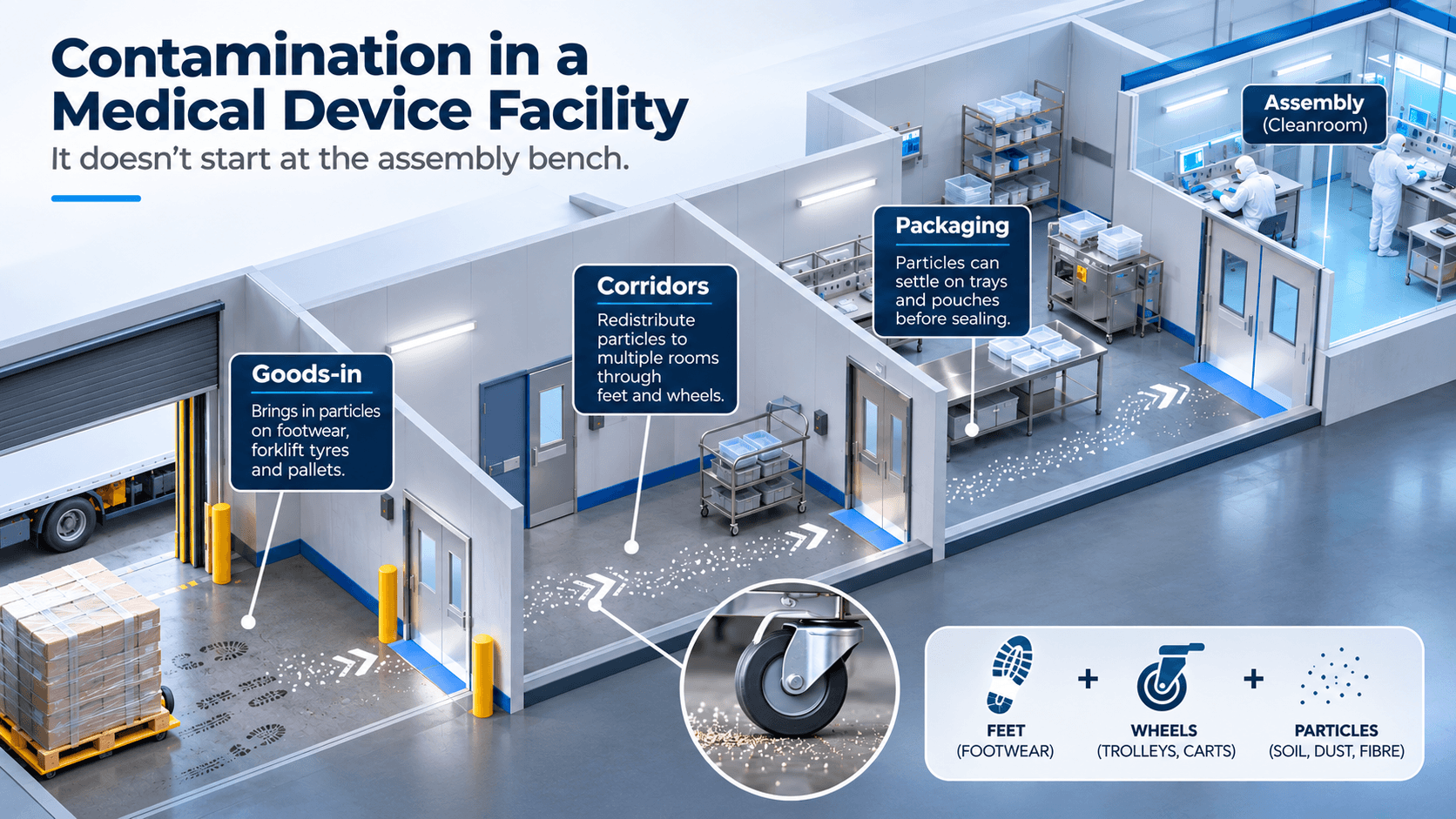
Ask where a medical device cleanroom gets contaminated and most people point to the assembly bench. Yet particles found there usually began their journey somewhere far less watched: a loading bay, a shared corridor, a packaging hall.
A cleanroom’s ISO 14644-1 classification describes the air inside the room, not what crosses the threshold on soles and wheels. This article follows that route through the spaces between rooms.
Why the in-between spaces get less scrutiny
Corridors, goods-in and packaging areas are often unclassified, so they attract fewer audit questions while carrying most of a site’s traffic: pallet trucks, trolleys, shift changes and contractors.
Since 2 February 2026, the FDA’s Quality Management System Regulation has incorporated ISO 13485:2016 by reference, so US contamination-control obligations now run through clause 6.4, the same clause EU and UK manufacturers already work to. For sterile devices, it specifically addresses particulate and microbial contamination during assembly and packaging. The implication: trace contamination to where it enters.
Three spaces where contamination enters the process
Goods-in: where the outside world arrives
Delivery footwear, forklift tyres and pallet wheels bring in soil, grit and fibre; cardboard and timber pallets shed more. Without a control point, the loading bay floor becomes a reservoir every internal trolley rolls across.
Good practice is a defined transfer zone where outer packaging is removed, goods move onto internal trolleys, and wheel-borne contamination is controlled at the bay threshold rather than at the cleanroom door.
Corridors: the multiplier
A corridor connects many rooms, so anything deposited there is redistributed to all of them. A trolley wheel collects particles around its circumference and redeposits them with every rotation. Cleaning schedules set by calendar rather than traffic leave busy periods under-controlled.
Packaging areas: the last step before the customer
Primary packaging usually happens inside the controlled area, but labelling and shipper operations often sit in an adjacent lower-grade space sharing warehouse traffic. Particles carried in on footwear can settle on trays and pouches before sealing, and particulate in a seal zone can compromise seal quality.
Map the route, not just the room
Walk one component’s path from dock to dispatch and record every floor transition. At each, ask:
• What crosses it? Feet, wheels or both, and how often per shift.
• What is the cleanliness step? Uncontrolled to controlled, or controlled to classified.
• What control is in place? Cleaning frequency, segregated trolleys, gowning, or contamination control flooring.
Busy wheeled transitions with no defined control are where footwear contamination control and wheel control add most value.
Washable cleanroom mats as a sticky mat alternative
Peel-off tacky mats have long been the default at cleanroom entrances, but their design suits pedestrian doors better than busy goods routes. Approaches have moved towards reusable cleanroom matting cleaned in place:
Traditional Tacky / Sticky Mat
How particles are held: Adhesive film on a stack of peel-off sheets.
Restoring the surface: Loaded top sheet is peeled away and discarded.
Wheeled traffic: Layered disposable sheet surface.
Waste stream: Single-use sheets are discarded after use.
Polymeric Contamination Control Mat
How particles are held: Tacky polymer surface that is cleaned in place.Restoring the surface: Surface is washed or wiped according to the cleaning SOP.
Wheeled traffic: Single bonded surface across the walk-off length.
Waste stream: Reusable surface with a stated service life of 3–5 years.