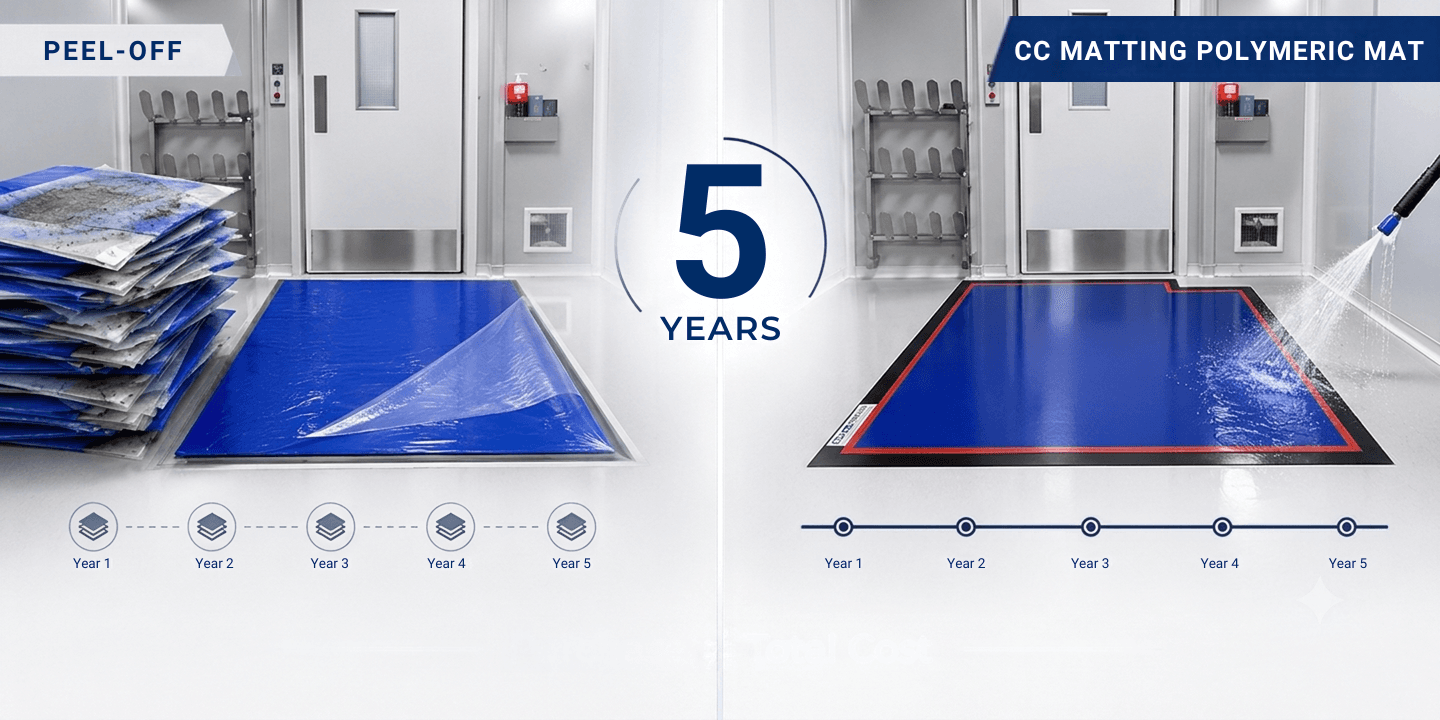
Peel-off mats rarely need a capital request. They arrive as a line on a consumables order, then again the next month, and the month after that. Because the spend is spread across small, routine purchases, few sites ever add up what their entrance matting costs across the life of a facility.
That is the gap this article addresses. The real question in a TCO comparison is not the price of a sticky mat pad against a square metre of polymer. It is a consumables model against a cleaning model, and which one costs your site less once every hidden line is counted.
At a Glance: Sticky Mats vs Reusable Cleanroom Matting
Factor
Peel-off sticky mats
Polymeric contamination control mats
Cost model
Recurring consumable (opex)
Upfront investment, then maintenance
What gets replaced
Adhesive layers and whole pads, continuously
The mat, at end of service life
Main cost driver
Number of peel events per year
Cleaning frequency set by your SOP
Main labour task
Peeling and restocking
Cleaning in place
Waste generated
Every peeled sheet, plus pad backing and packaging
The mat at end of life, plus cleaning wipes
Service life
One adhesive layer at a time
3–5 years (CC Matting technical data sheet)
Performance evidence
Varies by product; ask your supplier for data
For CC Matting: third-party test reports in the Quality & Efficacy Manual
The rest of this article explains how to put real numbers against each row.
The Real Driver of Sticky Mat Cost: Peel Events, Not Pad Price
Sticky mat budgets are usually discussed as a pad price. The number that actually drives cost is how often a layer is removed. That figure is set by your SOP, your traffic and how quickly each layer loads with debris.
A simple way to size it:
Annual sheets used = entrances × peels per entrance per day × operating days
Take a mid-sized site as a worked example. It has four matted entrances, peels once per shift on a three-shift pattern, and operates 250 days a year:
• 4 × 3 × 250 = 3,000 sheets per year
• Over five years: 15,000 sheets
• On a 24/7, 365-day operation, the same site uses 4,380 sheets a year
Divide by the number of layers per pad on your supplier’s specification to get annual pad volume. Then multiply by your contracted unit price. This is the base consumables figure, and it rises in line with traffic. A busier corridor, or a stricter peel frequency after an audit finding, increases spend immediately.
The Costs That Sit Around the Pad Price
The pad price is only the visible part. A full sticky mat cost line should also include:
• Procurement and receiving: raising orders, goods-in checks and invoice processing, repeated every order cycle.
• Storage: space for buffer stock near controlled areas, which is often expensive space.
• Peeling labour: each peel is a short task, but it happens thousands of times a year.
• Disposal: collecting and removing used sheets and backing material.
• Stock-out exposure: a missed delivery leaves an entrance uncontrolled, or loaded layers stay in use longer than intended.
None of these appear on the pad invoice, but all of them are real running costs.
What the Polymeric Side of the Ledger Really Contains
A fair TCO model does not treat reusable cleanroom matting as “buy once, forget”. It has its own cost lines, and they belong in the comparison.
Upfront Investment
This covers the material and installation. CC Matting’s heavy-duty polymeric matting is supplied in 2.0 m widths with no fixed length limit. That means it can be sized to the full stride length or trolley run of an entrance rather than to a standard pad footprint. CC Matting installs in Ireland and the UK and distributes worldwide.
Cleaning: The Honest Counterpart to Peeling
Washable contamination control mats replace peeling with cleaning. Cleaning takes labour and consumables, typically wipes and a compatible cleaning agent. How often you clean is decided by your contamination control SOP, not by the mat supplier.
For context, in the independent particle-removal study referenced in CC Matting’s Quality & Efficacy Manual, the mat was cleaned with 70% isopropyl alcohol and lint-free cleanroom wipers before testing. The product’s safety data sheet lists acetones and abrasive agents as materials to avoid. Both points matter when you cost and validate a cleaning routine.
Service Life and Warranty
CC Matting’s technical data sheet specifies a 3–5 year lifetime with a full two-year warranty. This lifespan is the denominator of the TCO calculation. The upfront cost is spread across every month the mat stays in service.
Building a 3–5 Year TCO Model
The most defensible business cases compare the two approaches line by line, over the same period, using your own quotes.
Cost component
Peel-off model
Polymeric model
Material
Pads × unit price, every year
Mat + installation, once
Freight and procurement
Every order cycle
Once per installation
Storage
Ongoing buffer stock
Minimal
Routine labour
Peeling and restocking
Cleaning to SOP
Routine consumables
None beyond the pads
Wipes and cleaning agent
Waste handling
Continuous
Low; the mat at end of life
Replacement
Built into consumption
At end of service life
Then calculate the break-even point:
Break-even (months) = polymeric upfront cost ÷ (monthly sticky mat cost − monthly polymeric running cost)
If break-even falls well inside the warranty period, the case is financially robust. If it only works at the far end of the lifetime range, it depends more heavily on your assumptions.
Stress-Test the Model at Three Years
A prudent model uses the low end of the lifetime range. Test the business case at three years, not five. If the numbers still work at three, any service life beyond that is additional saving rather than something the case depends on. Finance and QA reviewers tend to trust a case built this way.
It is also worth running a sensitivity check on peel frequency. Sites often find that their written SOP and their actual peel rate differ. The actual rate is the one that determines spend.
Waste Reduction: What Actually Leaves the Building
Going back to the worked example, 15,000 peeled sheets over five years is a physical waste stream. It needs handling, bagging and removal, and pad backings and packaging add to it. Adhesive-coated film is generally not a straightforward recycling stream, so check the options with your waste contractor.
With a polymeric mat, the main waste item is the mat itself at the end of its service life, plus cleaning wipes along the way. CC Matting’s safety data sheet recommends recycling where possible. Otherwise, landfill or incineration should follow local regulations.
For sites with sustainability targets or single-use plastic reduction commitments, fewer disposal events at every entrance is often part of the business case in its own right, alongside the financial return.
The Costs That Never Appear on an Invoice
TCO also includes the cost of the control not working as intended.
Performance consistency. A tacky layer captures particles well when fresh. As it loads with debris, its effectiveness depends on staff peeling at the right time. A missed peel has no cost on paper but can have a cost in practice. When you evaluate any matting, ask what capture data exists and under what conditions it was measured.
Documented efficacy. For CC Matting’s polymeric matting, CPC Laboratories measured particle removal from shoe soles and trolley wheels contaminated on a warehouse floor. Results:
• Particles above 5 µm: 91.8% removal (footwear) and 90.1% removal (trolley wheels)
• Particles above 100 µm: 100% removal
• Fibres above 100 µm: 92–100% removal
Note that these results apply to that study’s specific materials and method.
Secondary properties. A single mat surface can combine several functions that would otherwise need separate controls. For CC Matting, independent testing reports:
• Particle emission suitable for ISO Class 5 environments (Fraunhofer IPA, ISO 14644-1)
• Static-dissipative surface resistivity of 1×10¹⁰ Ω/sq (CISD, TUS Athlone)
• Low slip risk in both dry and wet pendulum tests (BS EN 16165:2021)
• Antibacterial activity under ISO 22196:2011: 99.92% reduction of E. coli and 99.21% reduction of MRSA
Validation effort. Every change to a controlled environment goes through change control. A matting product supported by consolidated third-party documentation takes less time to qualify than one assessed from scratch. That is a real, if rarely costed, saving in QA hours.
Regulatory context. EU GMP Annex 1 (2022) requires sterile manufacturers to maintain a documented contamination control strategy. Matting is one element within that strategy, and no mat on its own makes a facility compliant. The choice of matting should be justified in the context of your wider controls on personnel, materials and cleaning.
When Peel-Off Mats Can Still Make Sense
A credible TCO analysis also shows where a sticky mat alternative will not pay back:
• Short-term or temporary areas, such as construction interfaces or shutdown projects, where the space will not exist long enough to recover an upfront investment.
• Very low-traffic doors, where peel frequency is so low that annual consumable spend is minimal.
• Leased or transitional spaces, where a permanent installation is not practical.
For high-traffic entrances, gowning-room approaches, and corridors carrying both people and trolleys, the arithmetic usually changes. That is where continuous consumption costs build up fastest.
Where Polymeric Matting Fits in the Wider Strategy
The strongest TCO cases treat contamination control flooring as infrastructure rather than a consumable. It sits at the interfaces where footwear contamination control and wheel-borne transfer matter most: the transitions between uncontrolled and controlled zones.
CC Matting’s heavy-duty reusable contamination control matting is documented in a Quality & Efficacy Manual prepared for IQ/OQ/PQ use. A Certificate of Conformance is issued with each batch and installation. For pharmaceutical, medical device, semiconductor and laboratory sites, that documentation is often what turns a financial case into an approvable one.
Frequently Asked Questions
How do I calculate the true annual cost of sticky mats?
Multiply entrances by peels per day and operating days to get sheets used per year. Convert that to pads using your supplier’s layers-per-pad figure, then add freight, storage, peeling labour and waste handling. Pad price alone usually understates the true cost.
How long do polymeric contamination control mats last?
It varies by product and traffic. CC Matting’s technical data sheet specifies a 3–5 year lifetime with a two-year warranty. For budgeting, model at the lower end of the range so the business case does not depend on maximum service life.
Do washable cleanroom mats have running costs?
Yes. Reusable mats replace consumable pads with cleaning labour and cleaning materials such as wipes and a compatible agent. Your SOP sets the frequency. A fair TCO comparison includes these costs rather than treating reusable matting as maintenance-free.
Are polymeric mats suitable for ISO Class 5 cleanrooms?
Check the evidence for the specific product. CC Matting’s polymeric matting was classified as suitable for ISO Class 5 environments following Fraunhofer IPA particle-emission testing to ISO 14644-1. Suitability for your site still depends on your own risk assessment and contamination control strategy.
Is switching from tacky mats a change control matter?
In GMP environments, usually yes. Changing a contamination control measure normally goes through change control and qualification. Third-party test documentation that can be referenced directly in IQ/OQ/PQ protocols reduces the effort involved.
Next Step
If you are building a business case, start with your actual peel frequency and entrance count, then compare that consumption figure against a quoted installation. You can request the CC Matting Quality & Efficacy Manual to support the QA side of the evaluation, or contact the team to discuss sizing for your specific entrances and trolley routes.