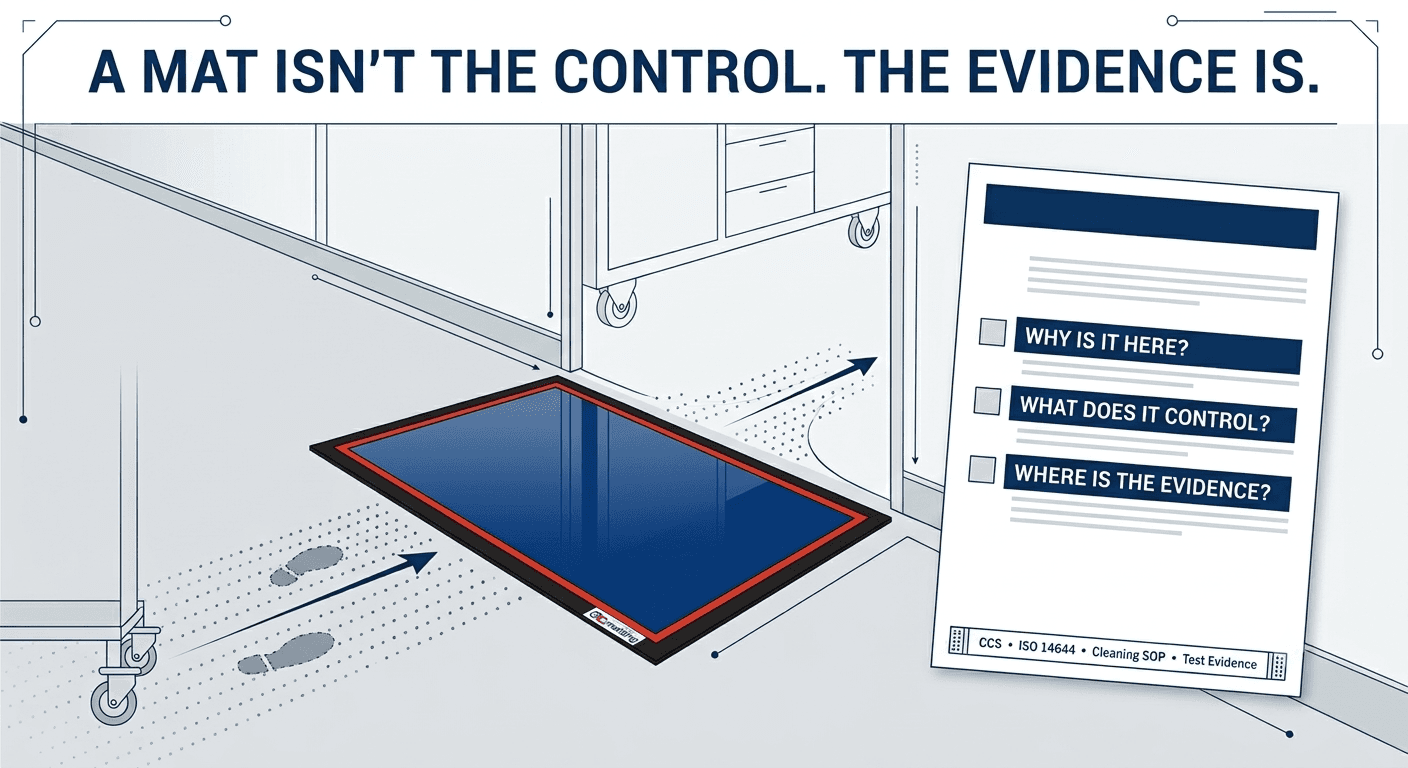
Auditors rarely ask whether there is a mat at the cleanroom door. They ask why it is there, what contamination route it controls, and how you know it works. That shift, from "is it installed?" to "is it justified and evidenced?", is where many entrance-area controls quietly fall short.
Since the revised EU GMP Annex 1 took effect in August 2023, sterile manufacturers are expected to maintain a documented Contamination Control Strategy (CCS) covering contamination sources and controls across the facility. Floor-level controls at gowning rooms, airlocks and material transfer points belong in that picture. This article looks at reusable cleanroom matting from the auditor's side of the table.
Sticky Mat Alternative or Sticky Mat: What an Auditor Will Check
There is no single "best" cleanroom matting. What an auditor tests is whether your choice is supported by evidence and controlled by procedure. The table compares the two common formats on audit-relevant points.
Audit point
Peel-off sticky (tacky) mats
Polymeric contamination control mats (CC Matting data)
How it works
Stacked adhesive sheets; the loaded top sheet is peeled off and discarded
Continuous polymer surface, cleaned in place
Service life
Single use per sheet
3–5 years stated lifetime (Technical Data Sheet)
Routine handling step
Manual peel carried out in the transition zone
Scheduled cleaning under your SOP
Particle removal evidence
Depends on the supplier's test data
Over 90% in every tested particle and fibre category (CPC Laboratories)
Cleanroom suitability
Depends on the supplier's test data
Particle emission within ISO Class 5 (Fraunhofer IPA, ISO 14644-1)
ESD behaviour
Check supplier data
1×10¹⁰ Ω/sq, static-dissipative (IEC 61340 method)
If you are weighing a tacky mat alternative, the deciding question is the same for either format: can you put the evidence in front of an inspector?
Where Cleanroom Entrance Mats Create Audit Risk
A control with no documented rationale
A mat placed "because we always have one there" is hard to defend. Your CCS should state what the mat controls (footwear contamination control, trolley and cart wheels), where it sits in the personnel or material flow, and why that location was chosen. <br>
Evidence that does not match what is on the floor
Test certificates relate to a specific product, and often a specific variant. The Fraunhofer IPA certificate for CC Matting, for example, names the material tested and carries a five-year validity date. Check that the product code on each certificate matches what is installed, and file the Certificate of Conformance issued with each batch and installation.
Procedures that are not followed
Inspectors compare SOPs with practice. Cleaning frequency, approved agents and records must line up. For CC Matting's polymeric mats, the Material Safety Data Sheet lists acetones and abrasive agents as materials to avoid, so your cleaning SOP should reflect that.
Aligning Reusable Cleanroom Matting with ISO 14644
ISO 14644-1 classifies cleanroom air by airborne particle concentration. Any material installed in a controlled area should not compromise the room's target class. Under reel-on-disc testing simulating foot and trolley traffic, Fraunhofer IPA classified the particle emission of CCM Heavy Duty Polymeric Matting within ISO Class 5.
Capture is the other half. In a CPC Laboratories walk-off study, removal of particles above 5 µm was 91.8% from shoe soles and 90.1% from trolley wheels, with 100% of particles above 100 µm removed. For semiconductor and optics sites that monitor airborne molecular contamination under ISO 14644-8, ASTM E595 outgassing results were TML 0.29% and CVCM 0.08%.
One caution: ISO Class 5 mats do not classify your room. Classification still rests on your own monitoring data.
Mapping Washable Cleanroom Mats to GMP Expectations
EU GMP Annex 1 does not prescribe floor matting. It expects contamination risks to be understood and controlled, with the rationale recorded. CC Matting's Quality & Efficacy Manual is structured so that its third-party data can be referenced directly in a site's IQ/OQ/PQ protocols.
Surface hygiene between cleans also matters. The polymer includes a silver-ion antimicrobial additive; ISO 22196:2011 testing recorded a 99.92% reduction in E. coli and 99.21% in MRSA on the treated surface. That supports, but does not replace, your cleaning and disinfection programme. More detail for GMP sites is on our pharmaceutical contamination control mats page.
Contamination Control Polymeric Matting: ESD and Slip Questions
In semiconductor and electronics facilities, auditors will look at your ESD control programme. Surface resistivity between 10⁶ and 10¹¹ Ω/sq is classed as static-dissipative; CC Matting's polymeric mats measured 1×10¹⁰ Ω/sq. Health and safety reviewers will also ask about slip: pendulum testing to BS EN 16165:2021 returned 65 PTV dry and 57 PTV wet, both classified low slip risk.
Pre-Audit Checklist for Contamination Control Mats
• A CCS entry naming each mat and the contamination route it controls
• Current third-party certificates, matched to the installed product code
• Batch Certificate of Conformance on file
• Cleaning SOP with frequency, approved agents and completed records
• Installation date tracked against the stated service life
• ESD verification records where static control is required
The Audit Takeaway
A mat does not pass an audit. A documented rationale, matching evidence and a followed procedure do. To see the test data behind reusable contamination control matting, review our compliance documentation.
Frequently Asked Questions
Does EU GMP Annex 1 require contamination control mats?
No. Annex 1 does not mandate matting. It requires manufacturers to identify contamination risks and document how they are controlled within a Contamination Control Strategy. If mats form part of that control, their purpose, placement, evidence and cleaning should be recorded.
Are polymeric mats suitable for ISO Class 5 cleanrooms?
CC Matting's polymeric mats had their particle emission classified within ISO Class 5 by Fraunhofer IPA, supporting use in entry and transition zones of ISO Class 5 environments. Your room's classification still depends on your own particle monitoring.
What documents should I hold for cleanroom mats during an audit?
Keep third-party test certificates matched to the installed product, the batch Certificate of Conformance, the technical and safety data sheets, your cleaning SOP and records, and the CCS entry explaining why each mat is there.
How is a reusable mat audited differently from a sticky mat?
The questions are similar: is there evidence and a followed procedure? For sticky mats, auditors look at peel frequency and records. For reusable cleanroom matting, they look at cleaning frequency, approved agents, records and the product's stated service life.
Are CC Matting mats static-dissipative?
Yes. Surface resistivity was measured at 1×10¹⁰ Ω/sq, within the 10⁶–10¹¹ Ω/sq static-dissipative range, in testing by CISD at TUS Athlone using the IEC 61340 method.
Planning an audit or reviewing your entrance controls? Talk to our team about placement and documentation for your site.