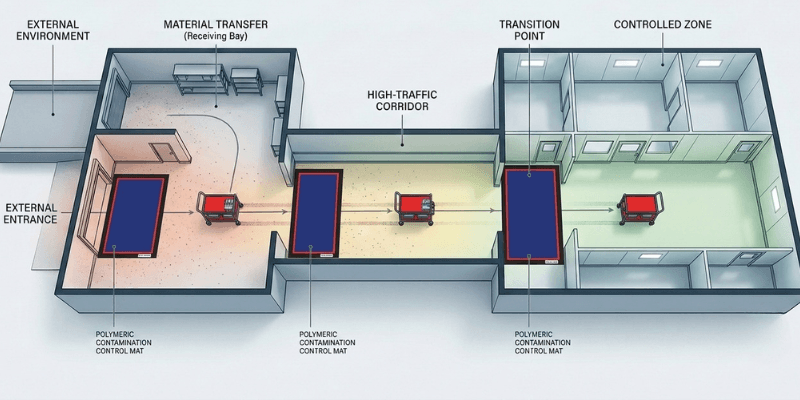
Control the Route, Not Just the Room
Most contamination control literature for medical device manufacturing starts inside the cleanroom: HEPA/ULPA filtration, gowning protocols, pressure cascades, environmental monitoring, bioburden testing. These controls are essential, and they are well documented. What gets far less attention is what happens before a person, a trolley, or a tool ever reaches that controlled space.
Contamination does not appear inside a cleanroom. It is carried there — on shoe soles, on wheels, on the underside of equipment, on the hands and clothing of people moving between zones. If the facility's entrances, corridors and transition points aren't treated as part of the contamination control strategy (CCS), the cleanroom is spending its filtration and gowning budget compensating for a problem that started at the front door.
This is the practical meaning of "sterile by design": designing the facility so that contamination is intercepted at each transition point along its route, rather than relying on a single line of defense at the cleanroom threshold. This article maps that route in detail, explains the mechanisms by which footwear, wheels and equipment movement introduce particulate and microbial load, and looks at where a specific and often overlooked control — polymeric contamination control matting — fits into a layered strategy.
The Contamination Pathway: From Outside to Sterile Zone
It helps to think of contamination control as managing a journey rather than protecting a room. A typical pathway looks like this:
1. External environment — outdoor dust, road grit, moisture and organic material collect on footwear and wheeled equipment before anyone enters the building.
2. Facility entrance / loading area — the first point where outside material is transferred onto interior flooring.
3. Corridors and traffic routes — shared paths used by personnel, trolleys, carts and material handling equipment moving between departments.
4. Transition zones (gowning rooms, airlocks, pass-throughs) — the last point before entry to a classified environment, where gowning and hand hygiene are typically enforced.
5. Controlled / classified production zone — where ISO 14644 classification, HEPA filtration and environmental monitoring take over
6. Sterile or high-grade process area — the zone with the lowest tolerance for particulate and microbial contamination, often feeding directly into sterilization and packaging.
Each stage either reduces contamination load or passes it forward. Facility design conversations tend to concentrate on stages 4–6, because that's where regulatory scrutiny and classification requirements are most explicit. Stages 1–3 are frequently treated as "outside the scope" of the CCS — which is precisely why they are worth examining closely.
How Footwear and Wheels Actually Transfer Contamination
The mechanism is straightforward but underappreciated. Footwear soles and wheel treads have textured, load-bearing contact surfaces. When they cross a contaminated floor, particulate matter, fibers and microorganisms become embedded in the tread pattern through pressure and friction. That material is then released incrementally with every subsequent step or rotation — not all at once, but across a series of contacts, which is why a single wipe, door mat or one-time gowning step rarely removes it completely.
Wheeled equipment introduces a second problem: continuous contact. A trolley wheel doesn't step once and lift — it rolls, maintaining sustained contact with the floor across its entire path. This makes wheels an efficient, low-visibility transport mechanism for particulate and microbial contamination between zones, especially where the same carts move between warehouse, corridor and production areas.
This is also why single-point interventions — one mat at one doorway, one alcohol wipe on entry — struggle to fully control the pathway. Removing contamination from a rolling or repeatedly-contacting surface generally requires multiple sequential contact points, not a single pass.
Why Traditional Tacky Mats Have Known Limitations
Adhesive "tacky" or "sticky" mats have been used at cleanroom and controlled-area entrances for decades, and the underlying idea — a floor surface that captures particulate on contact — is sound. The limitations relate to the mechanism and lifecycle of the product itself, not to the concept of entrance matting:
- Peel-layer shedding. Tacky mats work by presenting a fresh adhesive layer once the top sheet is peeled away. The act of peeling itself can generate micro-particulate and, in some conditions, airborne shedding at the exact point of use — a cleanroom entrance — which runs counter to the purpose of the mat.
- Performance drift across a sheet's life. Adhesion and capture performance are not constant from the first footstep to the last on a given layer; efficacy typically declines as the sheet accumulates debris, meaning contamination control is inconsistent within a single shift.
- Consumable lifecycle. Each layer is single-use, generating ongoing plastic waste and requiring a defined replacement schedule that has to be resourced and audited as part of the facility's procedures.
- Limited wheel performance. Adhesive sheets are effective for a footstep but are less suited to sustained rolling contact from trolleys and carts, which need repeated, mechanically consistent contact rather than a tacky surface.
None of this means tacky mats "don't work" — it means the mechanism has specific, well-understood constraints that a facility's CCS documentation should account for, particularly around consistency of performance and wheel traffic.
What Polymeric Contamination Control Matting Does Differently
Polymeric contamination control mats use a different mechanism: a durable, textured polymer surface that captures particulate and microbial contamination mechanically and abrasively as footwear or wheels pass across it, rather than relying on a peel-off adhesive layer. Because the surface isn't consumed with each contact, the same mat can be cleaned and returned to service — which is why this category is increasingly discussed as a washable contamination control mat or tacky mat alternative / sticky mat alternative, rather than a disposable good.
CC Matting's own testing illustrates how this mechanism performs under controlled conditions. In independent third-party testing (CPC Laboratories, Project 100825-1), CC Matting's Heavy Duty Polymeric Mat was challenged with particles and fibers collected directly from a contaminated warehouse floor — applied to both a shoe sole and a trolley wheel — and measured for removal efficiency across three particle categories (particles >5 µm, particles >100 µm, and fibers >100 µm). The mat achieved particle and fiber removal efficiencies exceeding 90% across all three categories in that study. It's worth being precise about scope here: this result reflects the materials, particle sizes and methodology used in that specific test, and manufacturers should request full test data relevant to their own contamination profile rather than treating any single figure as universal.
The material has also been evaluated for cleanroom compatibility in its own right. It holds a Fraunhofer IPA Certificate of Qualification, confirming that particulate emission during simulated tribological (friction) stress falls within the permissible values for ISO Class 5 air cleanliness — a relevant benchmark for facilities discussing ISO Class 5 mats for grade B/C-adjacent areas. Independent surface resistivity testing also places the material in the static dissipative range, relevant for semiconductor and electronics-adjacent medical device lines where electrostatic discharge is a parallel concern to particulate control. The matting additionally incorporates a silver-based antimicrobial additive (Addmaster Biomaster) and is rated by the manufacturer for a 3–5 year service life under a 2-year warranty — figures that support a lifecycle argument distinct from a single-use consumable, though actual service life will depend on traffic volume and cleaning regime at a given site.
None of this replaces gowning, airlocks, HVAC design or environmental monitoring. It addresses a specific, physically distinct stage of the contamination pathway — the transfer point between an uncontrolled surface and a controlled one — as one layer within a broader CCS.
Comparing the Two Mechanisms
Adhesive (Tacky) Mats vs Polymeric Contamination Control Mats
- Capture
Polymeric mats: Textured surface mechanically removes particles
- Footwear & Wheel Contact
Polymeric mats: Designed for both footwear and continuous wheel/trolley traffic
- Performance Over Time
Polymeric mats: Surface texture remains consistent through cleaning cycles
- Lifecycle
Polymeric mats: Reusable, cleaned and returned to service; typically 3–5 years
- Waste
Polymeric mats: Reduced consumable waste, with disposal generally at end of service life
- Static Control
Polymeric mats: Can be manufactured to a static-dissipative specification
- Antimicrobial
Polymeric mats: Can be manufactured with integrated antimicrobial additives
3–5 year typical service life depends on application and maintenance.
Where Entrance and Transition-Point Matting Fits in a Layered CCS
EU GMP Annex 1 requires manufacturers to document a contamination control strategy that identifies contamination sources and the controls in place to manage them — it does not prescribe a single product as the solution, and no mat, by itself, delivers regulatory compliance. What a documented CCS should reflect is where transfer risk exists and what specific control addresses each point. Practically, that means treating entrance and transition-zone matting as a distinct, named control in the CCS, positioned at:
External entrances and loading bays, before personnel and material handling equipment reach internal corridors.
Corridor-to-corridor transitions where high-traffic wheeled equipment routes cross between warehouse, general production and classified areas.
The final approach to gowning rooms and airlocks, so footwear contamination is reduced before gowning procedures begin — rather than relying on gowning alone to compensate.
Equipment and material transfer points, including pass-throughs and staging areas where carts and trolleys change zones.
Facilities positioning contamination control flooring at each of these points, rather than a single mat at a single door, are applying the same "control the route, not just the room" logic that facility-design guidance already recommends for personnel and material flow more broadly.
A Practical Way to Audit Your Own Facility
Before specifying any product, it's worth mapping your own facility against the pathway above. Ask:
Where does wheeled equipment cross from an uncontrolled area into a controlled one, and is that crossing point currently unmanaged?
Is your current entrance matting validated for cleanroom compatibility (e.g., ISO 14644 particle emission data), or is it a general-purpose product?
How is entrance matting cleaning and replacement documented, and does that documentation form part of your CCS?
Does your CCS name a specific control for footwear and wheel-borne contamination, or is it implied within a broader "personnel and material flow" section?
This kind of audit is often what surfaces the gap: contamination control strategies that are detailed on air handling and gowning but silent on the mechanics of the entrance.
FAQs
Do polymeric contamination control mats replace gowning and airlocks? No. They address footwear- and wheel-borne particulate transfer at entrances and transition points. Gowning, airlocks, HEPA filtration and environmental monitoring remain necessary controls for a compliant contamination control strategy.
Are contamination control mats suitable for medical device cleanrooms specifically, or only pharmaceutical facilities? The underlying mechanism — mechanical particle capture at a transition point — applies wherever personnel and wheeled equipment move between zones, including medical device, pharmaceutical and healthcare contamination control settings, provided the material is validated for the relevant air cleanliness class.
What's the difference between a tacky mat alternative and a standard entrance mat? A tacky mat alternative, such as a polymeric contamination control mat, is designed to be cleaned and reused rather than peeled and discarded layer by layer, while aiming to deliver comparable or documented particle capture performance validated against cleanroom-relevant test methods.
Does using a contamination control mat mean a facility is Annex 1 compliant? No single product delivers compliance. Annex 1 requires a documented, facility-specific contamination control strategy; entrance and transition-point matting can be one named control within that strategy, alongside gowning, airflow design and monitoring.
How often should contamination control matting be cleaned or replaced? This depends on traffic volume, contamination load and the manufacturer's tested service life. Cleaning and replacement intervals should be defined in your facility's procedures and supported by the product's technical data sheet rather than assumed.
Next Step
If you're mapping your own facility's contamination pathway and want to see where entrance and transition-point matting fits alongside your existing gowning and airflow controls, CC Matting's technical data sheets and independent test reports (particle removal efficiency, ISO Class 5 qualification, static dissipative rating) are available to support your contamination control strategy documentation — a useful starting point whether you're a facilities manager, QA lead, or evaluating a new contamination control mat supplier or contamination control mat distributor for a multi-site rollout.