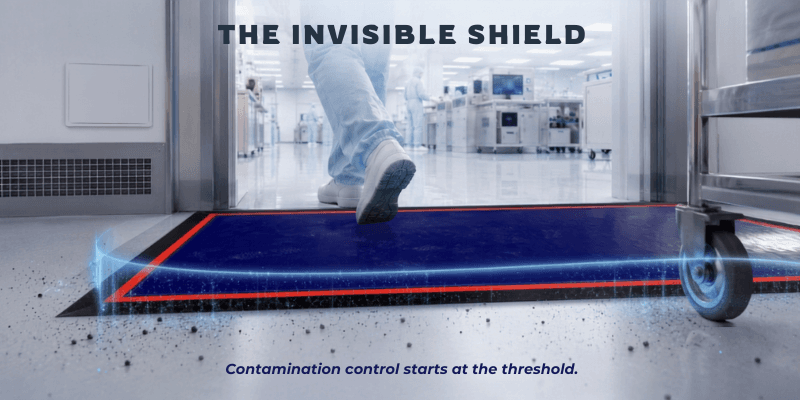
The Invisible Shield: How Clean Room Floor Mats Help Keep Sensitive Areas Clean
Contamination control polymer mats provide a critical first line of defence against particles entering controlled environments. CC Matting combines high particle capture, zero outgassing, static dissipation, antimicrobial properties, slip resistance, and washable performance to help protect equipment, improve safety, support compliance, and reduce the costs and waste associated with disposable mats.
CC Matting
Published on Aug 14, 2026
10 Ways Contamination Control Polymer Mats Are Protecting Critical Environments How a simple threshold solution stops 80% of floor debris, protects sensitive equipment, and saves your bottom line.
Contamination in high-stakes environments such as semiconductor fabs, pharmaceutical compounding labs, and medical device manufacturing facilities is not a minor inconvenience. This could have a potentially huge impact on the amount of product produced and result in disastrous financial losses. Facility engineers and cleanroom managers may spend big bucks on multi-stage HEPA filtration systems and strict gowning protocols, but one of the biggest sources of contamination is often at ground level.
Data shows that as much as 80% of all cleanroom contamination enters through shoe soles and wheeled equipment. If the entry point is not properly designed as a barrier, each personnel step introduces viable and non-viable particulates into the critical areas. High-performance clean room floor mats act as an invisible barrier to these microscopic contaminants, trapping them before they can affect sensitive processes.
Here are 10 critical ways advanced contamination control polymer mats, featuring the precision engineering of CC Matting, protect your facility, support regulatory compliance, and safeguard your bottom line.
1. Improved Particle Capture Using Engineered Polymers
Performance varies drastically among floor barriers. High-grade polymeric mat solutions bond with particulates at the molecular level by high surface energy instead of temporary, transferable glues that transfer onto footwear. CC Matting is engineered with a unique surface that draws in dirt from footwear and wheels, yielding subtly when stepped on to conform to shoe treads. This mechanical deformation ensures the maximum surface touch contact so that fine dust remains contained, which basic models fail to achieve.
2. Eliminating Outgassing Risks in VUV and Lithography Zones
Airborne Molecular Contamination (AMC) is a serious risk for sensitive equipment in aerospace, semiconductor chip fabrication, and other applications. The condensation of volatile organic compounds (VOCs) on sensitive optical surfaces or silicon substrates is a potential problem with standard PVC flooring. CC Matting satisfies this with zero outgassing per ASTM E595. Contaminants are physically captured at the threshold, with no volatile compounds being released into sensitive, controlled air flows.
3. Mitigating ESD Risks at Critical Gateways
Static electricity and sensitive electronics are a volatile combination. Electrostatic fields attract dust to components like a magnet. A sudden triboelectric discharge can destroy micro-circuitry without warning. These charges are frequently generated by personnel walking on floor coverings. CC Matting contamination control polymer mats are inherently static dissipative, safely grounding electrostatic charges at the door and removing particulate matter.
4. Overcoming Tacky Mat Performance Saturation and Cost
Conventional peel-off tacky mats quickly lose their effectiveness. After a few passes, the low-grade adhesive layer is saturated with particles and loses its ability to trap additional contaminants until a new layer is manually peeled off. This results in high recurring costs of operation and an avalanche of contaminated plastic waste. CC Matting's permanent, washable polymeric mats offer 100% particle control all day, without the performance compromise or environmental burden of disposables.
5. Enhancing Safety with the Industry's Highest Wet Slip Rating
Facility managers are concerned about floor safety because cleanroom environments are frequently exposed to aggressive liquid sanitisation processes and strict washdown protocols. Floor mats often get slippery when wet and are a major liability. CC Matting is designed to minimise this risk and has the PTV 57 Highest Slip Rating in the Wet. That means your contamination control barrier continues to deliver reliable traction and worker protection even during rigorous cleaning cycles.
6. Preventing Microbial and Biofilm Proliferation
In life science and pharmaceutical environments, bacteria prevention is as important as dust collection. The wrong mat can be a growth medium for microorganisms. Engineered to meet full BPR/EPA compliance, CC Matting contains antimicrobial properties within its material matrix that inherently restrict the growth of microbes. This feature ensures that the mat’s function in bio-burden management remains constant over time by inhibiting the formation of layers of resilient organisms and biofilms on the mat surface.
7. Streamlining Global Regulatory Audits
Compliance defines how things get done in any industry with tight regulation. CC Matting's premium polymeric mat offers a streamlined audit trail for demanding facility reviews. These products are CE-marked and REACH-compliant and meet strict international standards. They do not contain any prohibited or restricted chemical substances and meet all the strict controls of world distribution networks.
8. Approved for ISO Class 5 Cleanroom Environments
Cleanroom components must operate perfectly under pressure without contributing to the particulate count of the facility in order to maintain the strict particle limits of an ISO Class 5 cleanroom environment. CC Matting contamination control polymer mats are specifically authorised for use. Unlike traditional floor coverings that can degrade, shed microfibres or delaminate over time, these mats maintain a high surface energy and structural integrity despite constant foot and wheel traffic. The flooring system enables facility engineers to maintain laminar airflow dynamics and meet the strict environmental conditions required for ISO Class 5 certification through zero material shedding and maximum particle immobilisation at the threshold.
9. Optimizing Standard SOPs and Ease of Maintenance
The best contamination control solution must be easy to maintain without disturbing daily operations. Such integrated floorings easily fit into the regular workflows, while disposable sticky mats require constant supervision and manual peeling. With CC Matting, regular cleanroom mopping techniques work perfectly when paired with authorised disinfectants. The wash cycle breaks the temporary bond that holds the dirt, releasing the trapped particles so they can be wiped away and fully restoring the mat’s original molecular adhesion.
10. Shielding Capital Equipment to Boost Production Yield
Stray particles can shorten machine life, cause early blockage in costly HEPA filters, and increase product defect rates in sensitive manufacturing zones. The installation of floor mats for advanced clean rooms at critical entry points such as gowning areas, airlocks, and material transfer passages add a critical layer of protection. An engineered solution like CC Matting results in longer machinery lifespans, lower filter replacement costs, and more consistent production.
Securing Your Thresholds
The floor must never be forgotten in contamination-controlled environments. The majority of debris in a cleanroom is introduced through foot traffic and wheeled equipment, and using outdated peel-off mats can create additional cost, waste, and performance limitations.
Upgrading to high-performance contamination control polymer mats offers a more engineered, reliable, and sustainable approach. Solutions like CC Matting help stop up to 99% of debris at the entrance and support compliance with ISO, ASTM and ESD standards. The result has been a cleaner facility, safer employees, better protection of critical equipment and more consistent processes.