Data Centers

Is Your Data Center One Dust Particle Away From Costly Downtime?

Most contamination discussions in data centers stop at HVAC filtration — but airborne filtration was never designed to catch what walks and rolls in through the front door. This article traces the full contamination pathway, from footwear and wheels at the entrance to the cooling systems and server hardware it eventually reaches, and breaks down where a layered contamination-control strategy — including entrance and transition-zone matting — can actually intercept it before costly downtime occurs.

CC Matting

Published on Sep 22, 2026

Is Your Data Center One Dust Particle Away From Costly Downtime?
A single dust particle rarely takes down a server. But a data center that ignores dust as a systemic risk is closer to costly downtime than most facilities teams assume — not because filtration has failed, but because filtration was never designed to stop the contamination that walks and rolls in through the front door. Most technical discussions of data center contamination focus on what happens after particulate matter reaches sensitive equipment: reduced airflow, thermal stress, electrostatic discharge (ESD), corrosion, connector and optical interference. These mechanisms are well understood. What's less often addressed is the far more operational question: how does contamination actually get into a facility, and where in that pathway can it realistically be stopped? This article focuses on that pathway — from the outside environment, through footwear, wheels and material movement, into the entrance, and on toward critical white space — and where a layered contamination-control strategy, including contamination control matting, fits into it.

Two Contamination Pathways, One Facility

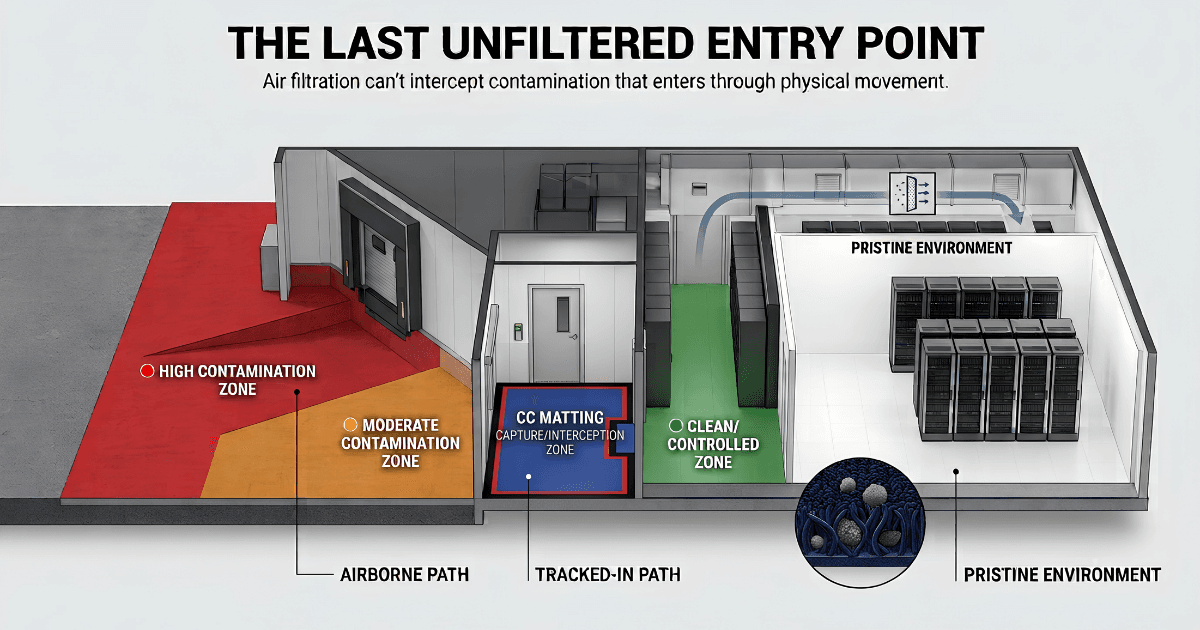
Data center contamination generally arrives through two distinct routes, and they require different controls.

Airborne contamination enters through HVAC intakes, unsealed building penetrations, and general infiltration. This pathway is addressed through filtration design, positive pressurization, and adherence to standards such as ISO 14644-1 for air cleanliness classification and ASHRAE TC 9.9 guidance on data center environmental control.

Tracked-in contamination enters through personnel, footwear, trolleys, carts, pallet jacks, and equipment being wheeled or carried into the facility. This pathway is physical, not atmospheric — and it is largely outside the scope of HVAC filtration entirely.

Treating these as one undifferentiated "dust problem" is where many contamination-control strategies fall short. A facility can meet its filtration specification and still accumulate significant particulate load from foot and wheel traffic at entrances, loading docks, and airlocks.

The Contamination Pathway: From Outside to Equipment

Tracked-in contamination follows a predictable route, and understanding each stage clarifies where intervention is actually possible.

1. Outside environment
Warehouse floors, loading yards, car parks and construction zones generate fine particulate, fibers, and larger debris that settle onto shoe soles, tires, and wheel assemblies.
2. Footwear and wheels
Every step and every wheel rotation transfers a portion of that surface contamination forward. Personnel entering server rooms, technicians wheeling replacement hardware, and cleaning or maintenance carts all act as contamination carriers, whether or not the facility has a formal gowning protocol.
3. The entrance and transition zones
Doorways, vestibules, airlocks, and loading docks are the last controllable point before contamination reaches conditioned space. This is the checkpoint most contamination-control strategies underutilize — either because entrance matting is treated as a housekeeping convenience rather than a technical control, or because it's absent entirely.
4. Critical areas and white space
Once inside, particulate is redistributed by airflow, foot traffic, and raised-floor air movement, settling on cable trays, server chassis, and cooling components.
5. Equipment and cooling systems
This is where the consequences documented in most technical literature actually occur — but by this stage, the contamination has already passed every control point that could have intercepted it.

What Dust Actually Does Once It Reaches Equipment

Understanding the mechanism matters more than the anxiety around it. Particulate contamination affects data center hardware through several distinct pathways:
Thermal insulation — dust accumulation on heatsinks, fan blades and PCBs acts as an insulating layer, reducing heat dissipation efficiency and forcing cooling systems to work harder.
Electrostatic discharge (ESD) — dry, non-conductive particulate can contribute to static buildup around sensitive components, a risk factor addressed through surface resistivity control in flooring specified under standards such as the IEC 61340 series.
Corrosion — dust that absorbs moisture or carries gaseous contaminants can accelerate corrosion on connectors, contacts and circuit boards.
Mechanical wear — abrasive particles affect moving components such as fans and drive mechanisms over time.
Optical and signal interference — fine particulate on fiber connectors and optical transceivers can degrade signal quality.
These mechanisms are cumulative rather than acute. A single particle is not the risk — a persistent, unmanaged intake of contamination over months and years is what shortens equipment life and increases unplanned maintenance. Any specific failure-rate percentages or temperature-increase figures circulating in general commentary should be treated cautiously unless tied to a named, verifiable source for your specific equipment and environment.
Why Filtration Alone Doesn't Close the Loop This is why guidance that stops at "improve filtration" leaves a structural gap. A layered contamination-control strategy has to address the entrance itself as a checkpoint, not just the air.
HVAC filtration, sealed penetrations, and positive pressurization are essential and effective against airborne particulate. But they do nothing to intercept contamination that enters via direct physical contact — a boot sole, a cart wheel, a pallet being rolled through a loading dock door. That contamination bypasses the air-handling system entirely and is deposited directly onto the floor, from where it becomes airborne again through foot traffic and air movement (re-suspension).

Building a Layered Strategy at the Entrance

A defensible contamination-control strategy for a data center typically combines several controls, each addressing a different pathway:
HVAC filtration and positive pressure address airborne infiltration by filtering particulate from incoming air and maintaining a pressure differential that limits the ingress of unfiltered air.
Sealed building penetrations help control airborne infiltration by eliminating uncontrolled entry points for dust and gaseous contaminants.
Vestibules and airlocks address personnel and material transfer by creating a buffer zone between the outside environment and the controlled space.
Entrance and transition matting addresses footwear and wheel-borne contamination by physically removing particulate from soles and wheels through repeated contact.
Material staging protocols help control contamination from wheeled equipment and pallet movement by reducing the direct transfer of yard or warehouse contamination into white space.
Housekeeping and monitoring address residual and airborne particulate through ongoing cleaning and verification of required cleanliness levels.
No single control closes the loop on its own. Contamination control matting addresses a pathway — footwear and wheel-borne particulate at the point of entry — that filtration and sealed building envelopes structurally cannot.

Where CC Matting's Contamination Control Mats Fit

Entrance and transition matting is already recognized as a standard control point in data center contamination strategies. The question most guidance leaves unanswered is what type of mat is doing that job at the entrance, because the mechanism matters as much as the placement.
CC Matting manufactures a heavy-duty polymeric contamination control mat designed as a washable, reusable alternative to single-use tacky mats. Rather than layering adhesive sheets that are peeled off and discarded once soiled a process that can itself generate microparticulate and fiber shedding at the point of removal, the CC Matting surface is cleaned in place and reused, which changes the maintenance profile at a high-traffic entrance and avoids the recurring plastic waste stream of single-use mat systems.
Shoe-sole and trolley-wheel walk-off testing against warehouse floor debris measured average particle and fiber removal efficiencies exceeding 90% across three categories: particles greater than 5 microns, particles greater than 100 microns, and fibers greater than 100 microns, the same footwear- and wheel-borne contamination pathway described earlier in this article. Fraunhofer IPA assessed the material against ISO 14644-1 and qualified it as suitable for ISO Class 5 cleanliness environments, and independent surface resistivity testing under IEC 61340 series methodology placed it within the static dissipative range, relevant given the ESD sensitivity of server hardware and raised-floor components. The mat also carries ISO 22196-tested antimicrobial treatment and ASTM E595-based outgassing/VOC screening and is rated for a 3–5 year service life under CC Matting's technical data sheet.
For a data center specifically, this positions CC Matting's mat as a transition-zone control at personnel entrances, loading docks, and the point where wheeled hardware or maintenance carts cross from unconditioned to conditioned space, one layer in the broader strategy outlined above, not a replacement for filtration, sealed penetrations, or housekeeping protocols. Facilities and QA managers evaluating a contamination control mat supplier or contamination control mat distributor for this application should expect this level of named, traceable test data as a baseline, rather than a general performance claim.

A Practical Starting Checklist

Before treating entrance matting as adequate, it's worth confirming:
Is the mat positioned to capture all foot and wheel traffic entering critical areas, including loading docks and material transfer routes — not just the main personnel door?
Does the mat's material and surface resistivity align with the facility's ESD protection requirements?
Is the maintenance protocol (cleaning frequency, replacement cycle) documented and followed, rather than assumed?
Does the mat's performance data come from a named, traceable test method — or is it a general marketing claim?
Is entrance matting treated as one layer within a documented strategy, alongside filtration, sealed penetrations, and housekeeping — rather than a standalone fix?

Where This Fits in a Broader Contamination-Control Strategy

Dust doesn't fail a server in isolation. It accumulates through a pathway that starts outside the building and passes through footwear, wheels, and transition zones long before it reaches a cooling fan or a fiber connector. Filtration and building envelope controls address the airborne half of that pathway. Contamination control matting — specifically, matting engineered and tested for particulate capture, ESD-relevant surface resistivity, and durable reuse — addresses the physical half, at the one point in the journey where contamination can still be intercepted before it enters critical space.
For facilities and QA managers reviewing entrance protocols, the practical next step is usually a walk-through audit of every point where personnel, carts, or material enter controlled space, mapped against the layered controls above.

Frequently Asked Questions


1) Does dust actually cause data center downtime, or is this overstated? Dust rarely causes a single catastrophic failure. Its risk is cumulative — reduced cooling efficiency, ESD exposure, and corrosion build up over time, increasing the likelihood of failure and unplanned maintenance rather than causing it outright.
2) Where does most contamination enter a data center? Contamination enters through two routes: airborne infiltration via HVAC and building penetrations, and physical tracked-in contamination via footwear, wheels, and material movement at entrances and loading docks. Both require separate controls.
3) Are entrance mats enough to stop data center contamination? No single control is sufficient on its own. Entrance matting addresses footwear and wheel-borne contamination specifically; it should be paired with HVAC filtration, sealed building penetrations, and documented housekeeping protocols.
4) What's the difference between a tacky mat and a polymeric contamination control mat? Tacky mats use disposable adhesive layers that are peeled off once soiled, which can generate shedding at removal. Washable polymeric mats are cleaned and reused, offering a different maintenance model and reduced disposable waste, though suitability depends on traffic and protocol.
5) Should data centers use the same contamination control mats as pharmaceutical cleanrooms? Not necessarily the same specification, but the underlying engineering criteria — particulate capture efficiency, ESD/static dissipative properties, and durability under sustained traffic — are relevant to both environments and worth evaluating against named test data.
CC Matting manufactures and distributes polymeric contamination control mats tested for particulate capture, ESD-relevant surface resistivity, and durability across pharmaceutical, medical device, semiconductor, data centre and laboratory environments. For technical specifications or to discuss entrance and transition zone layouts, contact CC Matting's technical team.