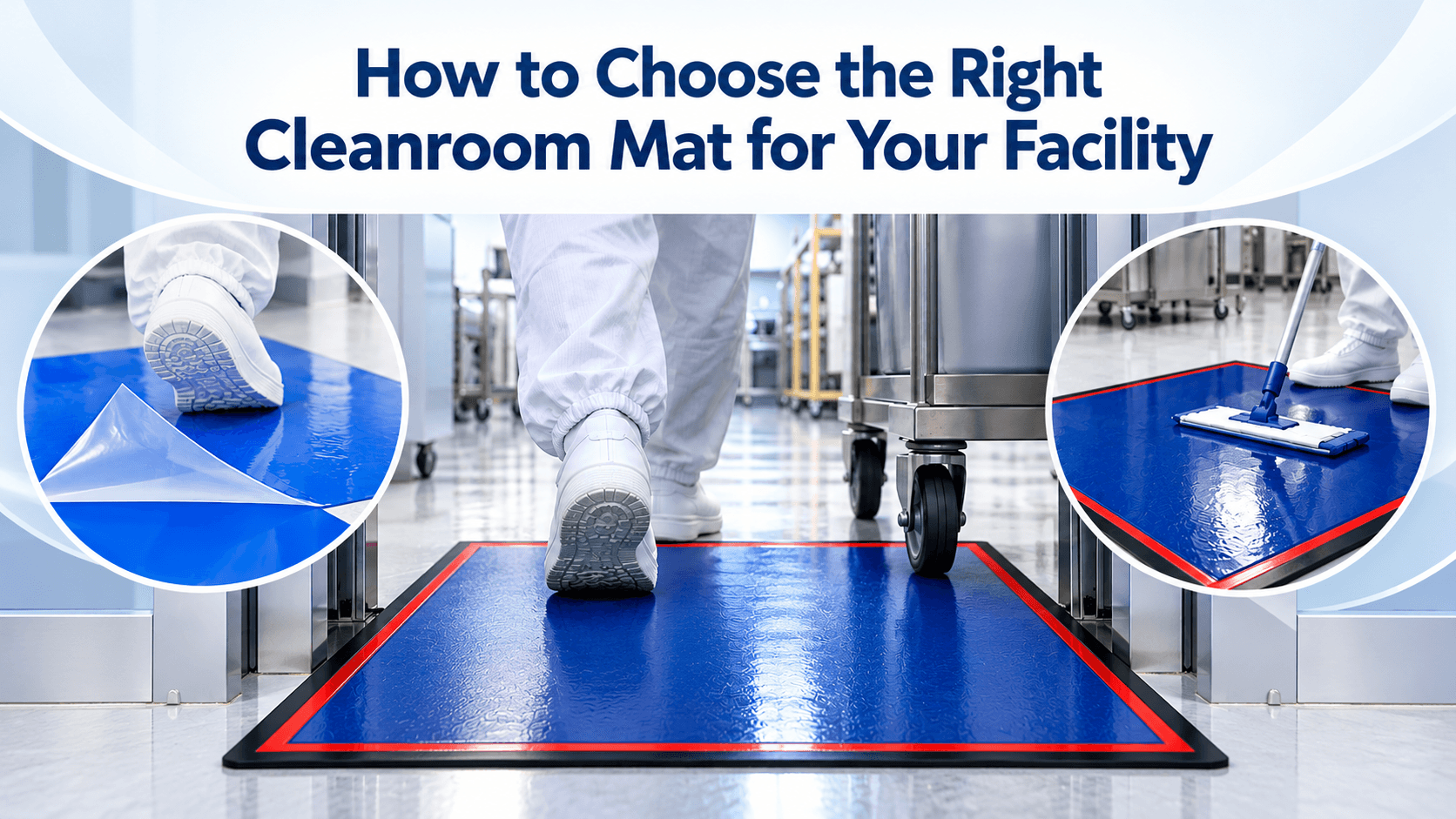
Most sites chose their cleanroom mats by purchase order, not decision. Yet the mat at the gowning-room door sits where every person, trolley and pallet jack crosses from a dirtier zone into a cleaner one.
So how do you choose a cleanroom mat that fits your traffic, cleaning regime and contamination control strategy? Specify it against evidence and use, not price per sheet.
What Is the Best Cleanroom Matting? A Quick Comparison
There is no single best cleanroom mat; it depends on what crosses the threshold and how the mat is maintained. Most facilities choose between single-use adhesive (tacky or sticky) mats and reusable polymeric contamination control mats.
1. Sticky / Tacky Mats
Particle Capture: Adhesive sheets trap particles on contact.
Surface Renewal: Used sheets are peeled off and discarded.
Wheeled Traffic: Sheet edges may lift or tear under trolley wheels.
Consumables: Requires replacement sheets at every change.
2. Polymeric Contamination Control Mats
Particle Capture: Polymeric surface retains particles through repeated contact.
Surface Renewal: Cleaned in place using a defined procedure.
Wheeled Traffic: Continuous surface accommodates rolling equipment.
Consumables: No replacement sheets; mat replaced at end of service life.
Step 1: Start With What Crosses the Threshold
A cleanroom mat is a control at an interface, so describe the interface first: who and what crosses it, how often, and from where.
Footwear from a warehouse corridor carries more than footwear inside a gowned area. Wheels are an easily overlooked second pathway: they pick up and redeposit contamination as they rotate, and a mat sized for feet may be too short for them.
EU GMP Annex 1 expects sterile manufacturers to maintain a documented contamination control strategy. Recording why each mat is there keeps the choice traceable rather than habitual.
Step 2: Size the Cleanroom Entrance Mat to the Stride, Not the Door
Removal happens through contact, so the number of times each sole or wheel touches the mat matters more than how neatly it fits the frame.
One independent laboratory study of CC Matting’s heavy-duty mat, for example, used three steps per shoe and a 90 cm wheel roll. Sizing cleanroom entrance mats so normal walking gives several contacts per foot brings real use closer to tested conditions. Cover the full doorway width; busy openings can be specified as a continuous run of contamination control flooring.
Step 3: Ask What Contamination Control Polymeric Matting Has Been Tested For
Whether buying pharmaceutical or healthcare contamination control mats, ask any contamination control mat supplier the same six questions. The following bullet points outline the expected evidence, using CC Matting’s test results as examples.
CC Matting – Quality & Performance Evidence - Particle Removal: CPC Laboratories confirmed 91.8% removal of particles >5 µm from footwear, 90.1% from wheels, and 100% of particles >100 µm. - Particle Shedding: Fraunhofer IPA verified material suitability for ISO Class 5 under abrasion testing. - Outgassing: ASTM E595 (modified, 50°C) testing recorded TML 0.29% and CVCM 0.08%. - Static Dissipation: TUS Athlone testing confirmed static-dissipative properties for ESD-sensitive environments. - Slip Resistance: BS EN 16165 testing recorded 65 PTV dry and 57 PTV wet, indicating low slip risk. - Antimicrobial Testing: ISO 22196:2011 test certificate supports the antimicrobial testing claim.
Read each report’s scope. A rating for ISO Class 5 mats describes the material’s own emission under test; it does not make a room ISO Class 5. Removal figures likewise apply only to the method used.
Step 4: Is Reusable Cleanroom Matting the Right Sticky Mat Alternative?
Tacky mats remain reasonable for temporary works or low-traffic doors where a consumable is simpler than a cleaning routine. Their limits show in busy, wheeled areas: each peel is a handling step at the threshold, sheets are consumed at every change, and capture depends on how loaded the current sheet is.
As a tacky mat alternative, polymeric matting shifts effort from replacement to cleaning, which suits heavy footfall and trolleys if cleaning is resourced. Compare whole-life cost: sheets and disposal versus installation, cleaning time and service life. CC Matting’s data sheet lists a 3–5 year lifetime with a two-year warranty.
Step 5: Plan How Washable Cleanroom Mats Will Be Cleaned
Washable contamination control mats are only as clean as their last wipe-down. Confirm:
• compatible cleaning agents (CC Matting’s safety data sheet lists acetones and abrasives to avoid)
• who cleans the mat, how often, and where that is recorded
• how wear is inspected and what triggers replacement
Written into the cleaning SOP, these link the mat to your wider footwear contamination control routine. A mat supports a compliant process; it does not deliver compliance alone.
Frequently Asked Questions
How long should a cleanroom mat be?
Long enough for several footfalls per foot and full wheel rotations, and as wide as the doorway. Measure the walking route, not the door frame.
Are tacky mats still acceptable in GMP cleanrooms?
GMP guidance does not prescribe a mat type. Tacky mats can be used where justified within the site’s contamination control strategy, weighing traffic, wheeled movement, peeling and waste.
What does an “ISO Class 5” rating on a mat mean?
Usually that the material’s particle emission, tested under defined conditions, fell within ISO 14644-1 Class 5 limits. It describes the mat, not the room.
How often should washable cleanroom mats be cleaned?
There is no universal frequency. Set it by traffic, zone grade and visible loading, record it in the SOP, and review it against environmental monitoring trends.
Can one cleanroom mat handle both foot and trolley traffic?
Yes, if tested for both and sized for wheels. Ask for wheel removal data separately, because the contact mechanics differ.
Next Step
Drafting a specification? The test evidence is summarised on CC Matting’s compliance and certification page, with formats on the reusable contamination control matting page. To review a threshold in Ireland or the UK, talk to the CC Matting team.

