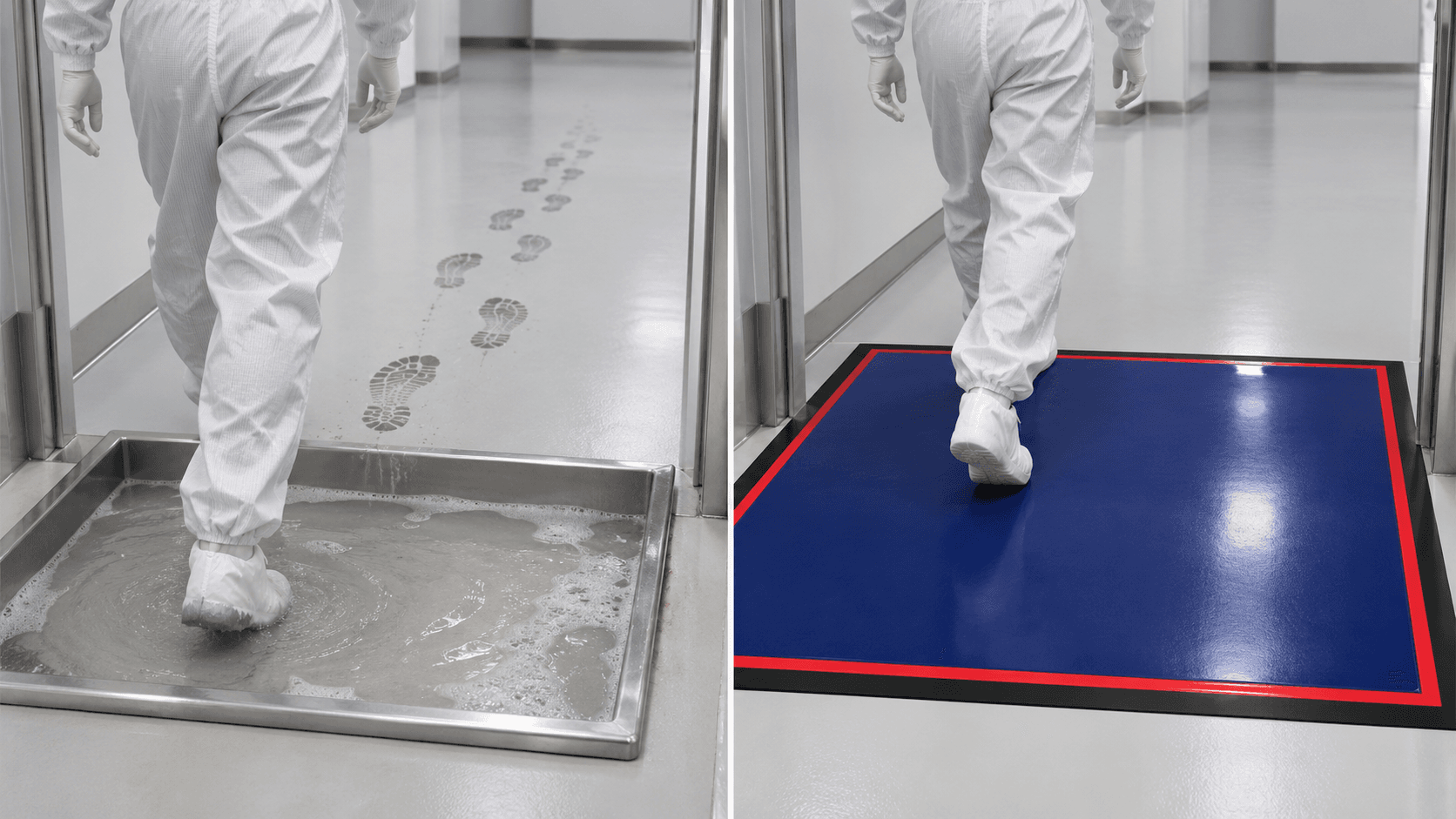
A tray of disinfectant at the door is one of the most visible signs of contamination control. Auditors see it, staff step through it, and it feels like protection. The harder question is what that step actually achieves in the second or two a sole spends in the solution, and what it carries onto the floor afterwards. Below, footbaths and saturated disinfectant mats are treated as one category: wet entry decontamination.
What a footbath is being asked to do
In one pass, a footbath must remove soil, inactivate microorganisms and release the wearer onto a cleaner floor without creating new hazards. Each of those jobs runs into a physical limit.
Six reasons to rethink wet entry decontamination
1. One step rarely delivers the contact time a disinfectant needs
Disinfectants are qualified at a defined concentration and contact time, usually on a surface that has been cleaned first. Nobody stands in a tray that long. The sole is wetted, not necessarily disinfected, and the rest of the dwell time happens on your floor.
2. Soil degrades the solution it lands in
EU GMP Annex 1 notes that for disinfection to be effective, prior cleaning to remove surface contamination should be performed. A footbath reverses that order: soiled soles go straight into the disinfectant. Organic load builds and concentration drifts, so a bath correct at 7 a.m. may be doing far less by mid-afternoon.
3. Wet soles are a slip risk at the worst possible point
Entrances are where people turn, step over benches and carry items. A film of liquid between sole and a smooth vinyl or epoxy floor raises slip risk precisely there, and for several steps beyond.
4. Residue travels onto the floors you are trying to keep clean
Annex 1 also states that cleaning programmes should effectively remove disinfectant residues. A footbath deposits a fresh trail of disinfectant footprints with every entry. Dried deposits can leave a film that holds particles, appear as visible residue at inspection and attack some flooring finishes.
5. Particles are relocated, not removed
Much of what soles carry is dry particulate and fibre. Liquid does not capture it; it turns it into a slurry the wet sole spreads. Moisture on floors is also a well-recognised enabler of microbial survival, which is the opposite of the intended outcome.
6. The management burden is easy to underestimate
Every footbath needs preparation, concentration checks, change-outs, logs, disinfectant rotation and safe handling of concentrates, each a potential deviation. Footbaths also cannot treat trolley or cart wheels, which often share the same doorway.
The dry alternative: capture rather than soak
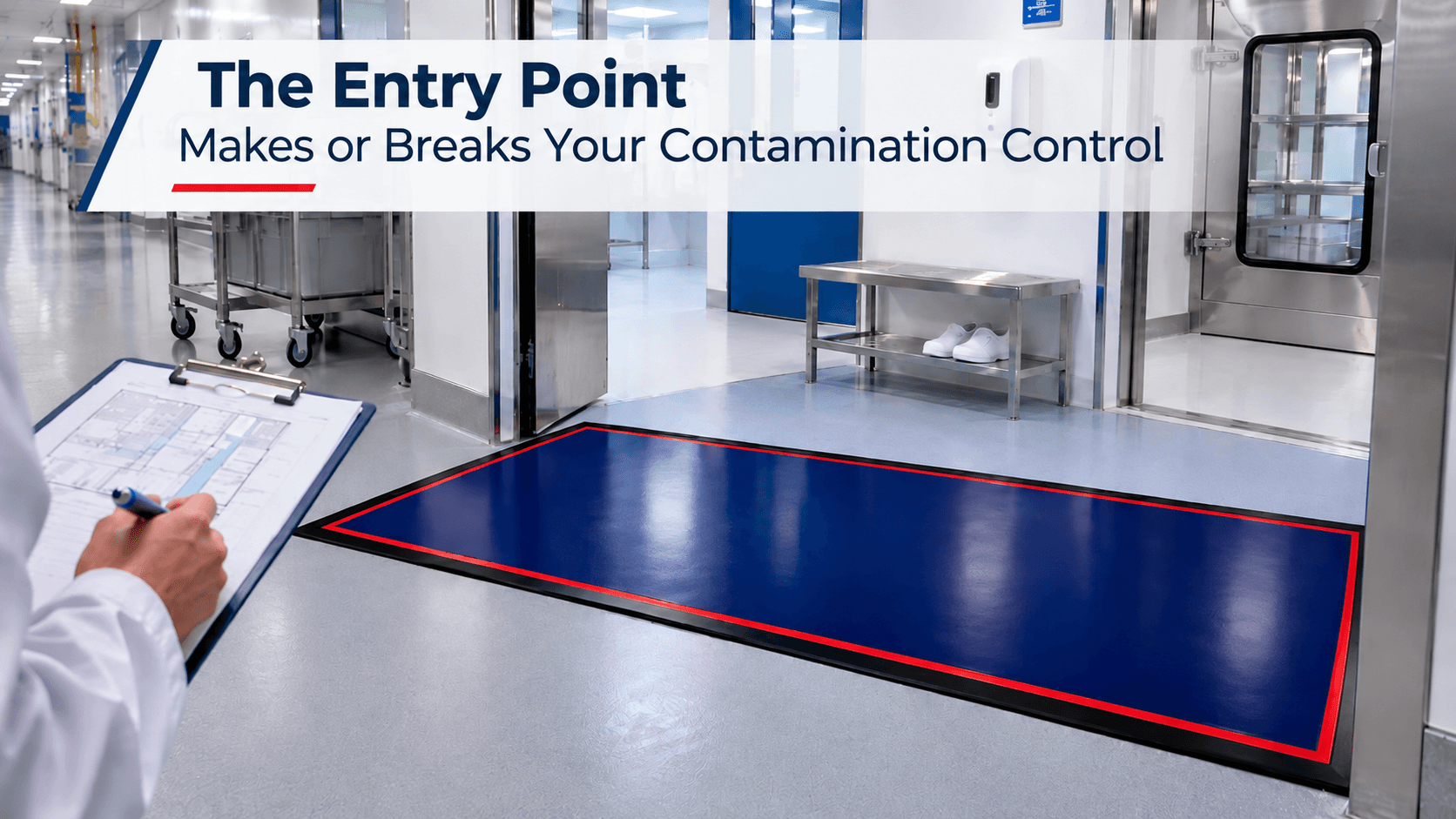
Dry entry methods work by physically pulling particles from soles and wheels over several contact steps, leaving the floor beyond dry. Peel-off tacky mats do this with single-use adhesive layers that are discarded as they load.
Polymeric contamination control mats take a reusable approach: a washable polymer surface that is cleaned in place rather than thrown away.
For sites assessing a footbath replacement or sticky mat alternative, the CC Matting polymeric contamination control mat offers:
• Slip resistance: 65 PTV dry and 57 PTV wet, both well inside the low slip-risk band, which begins at 36 PTV.
• Static dissipative surface, relevant where electrostatic discharge matters alongside particulate control.
• Silver-based antimicrobial additive integrated into the material itself.
• Material suitable for ISO Class 5 environments.
• Service life of 3 to 5 years, cleaned with routine wiping; acetones and abrasive agents should be avoided.
One qualifier matters: an antimicrobial mat surface supports hygiene at the entrance but does not replace a site’s cleaning and disinfection programme.
When wet methods still make sense
Wet decontamination is not obsolete; it is suited to a different problem. It remains appropriate where:
• Footwear carries heavy organic soil, such as in animal facilities, vivaria or outdoor yards, where scrubbing and a defined dwell time are needed.
• A biosecurity or outbreak protocol specifies a named agent and contact time.
• A dedicated boot-wash station cleans, disinfects for a set time and dries footwear as a controlled process rather than a pass-through tray.
Many facilities use both: wet treatment at the outer boundary for gross soil, and contamination control matting at the controlled-zone interface. Whatever the choice, the rationale belongs in the site’s contamination control strategy. No mat or footbath on its own guarantees regulatory compliance.
A quick way to decide
• Is the main load on soles dry particulate or wet organic soil?
• Can the required disinfectant contact time realistically be achieved at this point?
• What floor finish lies beyond the entrance, and how slippery is it when wet?
• Do wheels and trolleys use the same doorway?
Frequently asked questions
Do footbaths disinfect cleanroom footwear effectively?
Usually not on their own. Disinfectants need a defined contact time on a pre-cleaned surface, and a brief step through a tray rarely provides either. Soil entering the solution can also reduce its effectiveness over a shift.
Are disinfectant foam mats better than footbaths?
They hold less liquid and splash less, but share the same limits: contact time, soil loading, residue and wet-sole slip risk.
Does EU GMP Annex 1 ban footbaths?
No. Annex 1 does not prohibit footbaths. It does expect cleaning before disinfection, removal of disinfectant residues and a documented contamination control strategy, which makes the limitations of footbaths relevant when justifying entrance controls.
How slip resistant is a polymeric contamination control mat when wet?
The CC Matting polymeric contamination control mat records 57 PTV wet and 65 PTV dry. Both values sit in the low slip-risk range, which starts at 36 PTV.
Next step
If your answers point to dry particulate and mixed foot-and-wheel traffic, review our polymeric contamination control mats or our cleanroom entrance mat placement guidance. To discuss a specific entrance,
contact CC Matting. We install in Ireland and the UK and distribute worldwide.