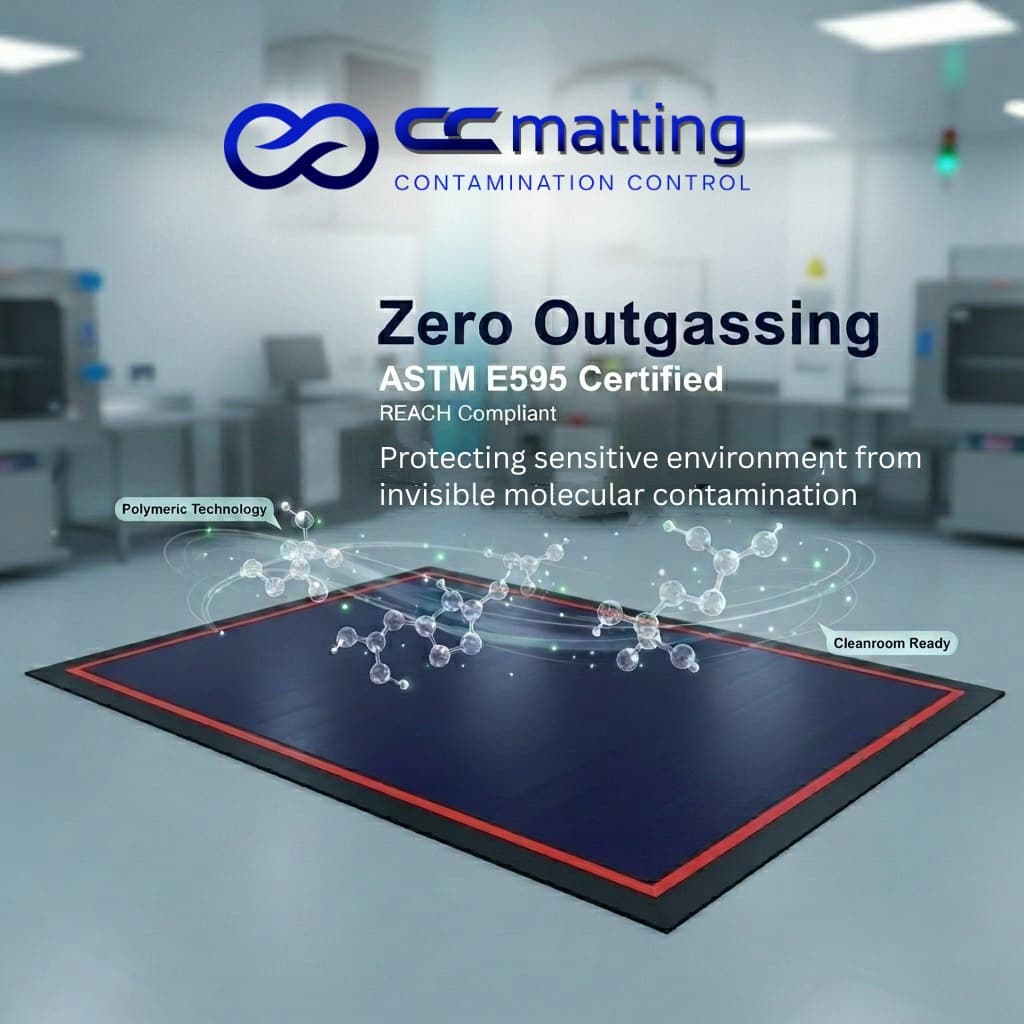
CC Matting’s Polymeric Matting is ASTM E595 Certified and Changes the game for advanced cleanrooms.
When engineering an elite-tier cleanroom environment—whether for semiconductor fabrication, cutting-edge biotechnology, or pharmaceutical compounding—the standard playbook focuses aggressively on particulate control. You calculate floor rotations, implement strict gowning policies, and run high-efficiency HEPA and ULPA filtration systems. But there is a silent, airborne threat that traditional filtration cannot catch: molecular outgassing. Many facility managers don't realize that the very materials brought in to protect the cleanroom can inadvertently pollute its atmosphere. Traditional floor mats, flexible plastics, and low-grade adhesives steadily release volatile organic compounds (VOCs) and chemical vapors directly into the cleanroom envelope.To eliminate this hidden risk, CC Matting has established a new benchmark for physical contamination control.
Our high-performance polymeric matting has been rigorously evaluated under ASTM E595 protocols, setting a definitive, low-outgassing standard for critical controlled environments.
What is outgassing?
Outgassing is the release of trapped gases, residual solvents, plasticisers or moisture from a solid material into the surrounding air.
The released molecules are gases, not particles. HEPA and ULPA filters are designed to capture particles, so gas-phase molecules can circulate through a cleanroom until they condense on a cooler surface.
Why outgassing matters for cleanroom floor matting
Floor matting sits at airlocks and gowning-room thresholds, where every person and trolley passes. A mat that outgasses adds vapour to the air at exactly the point where a facility is trying to control contamination.
- Semiconductor and optics: condensed vapours can leave residues on wafers, lenses and mirrors.
- Pharmaceutical and medical device: volatile compounds can add unwanted chemical traces to controlled environments and sensitive test areas.
- Data centres: vapour residues can settle on sensitive electronics alongside dust.
When specifying matting for these areas, ask for outgassing data as well as particle data.
What does ASTM E595 measure?
ASTM E595 is a widely used screening test for how much volatile material a solid releases. It reports three values.
- Total Mass Loss (TML): The percentage of the sample's original weight lost as volatile substances escape during testing. - Collected Volatile Condensable Materials (CVCM): The percentage of the sample's original weight that escapes and subsequently condenses on a nearby surface. This is particularly relevant when assessing potential residue on wafers and optical surfaces. - Water Vapour Regained (WVR): The amount of moisture the sample reabsorbs after the test.
CC Matting's outgassing results
- TML (Total Mass Loss)
CC Matting polymeric matting: 0.29%
Common screening level: ≤1.0%
- CVCM (Collected Volatile Condensable Materials)
CC Matting polymeric matting: 0.08%
Common screening level: ≤0.10%
- WVR (Water Vapour Regained)
CC Matting polymeric matting: 0.10%
Common screening level: Reported for information (no pass/fail threshold specified).
The testing was carried out by an independent accredited laboratory at a reduced test temperature, chosen to reflect cleanroom operating conditions rather than spacecraft conditions. At that temperature, the material met the historical screening levels referenced in ASTM E595.
As with any material test, the results apply to the material and conditions tested. Your own environmental monitoring remains the final check.
Outgassing vs particle emission: two different tests
A mat can contaminate a cleanroom in two ways: by releasing vapour, and by shedding particles under foot and wheel traffic. They are measured separately.
- Outgassing (vapour) What is measured: Volatile mass loss and condensable substances released by the material. CC Matting result: TML 0.29%, CVCM 0.08%.
- Particle emission (shedding) What is measured: Particles released from the material under friction or contact. CC Matting result: Material qualified as suitable for ISO Class 5 cleanrooms.
The matting's main job is removing contamination from shoes and wheels. In independent laboratory testing, it removed over 90% of particles larger than 5 microns from shoe soles and trolley wheels. Low outgassing means that job is done without adding vapour to the air.
The matting is reusable, static-dissipative and supplied 2.0 m wide, cut to length to cover the full width of a doorway.
Frequently asked questions
- What does ASTM E595 measure?
ASTM E595 measures how much volatile material a solid releases under vacuum and heat. It reports total mass loss (TML), collected volatile condensable materials (CVCM) and water vapour regained (WVR). Engineers use it to screen materials for use near sensitive surfaces.- What are TML and CVCM?
- What are CC Matting's outgassing results?
- Is low-outgassing matting suitable for semiconductor cleanrooms?