Before a QA manager approves reusable cleanroom matting, facilities usually ask: who cleans it, and with what? If the answer means new equipment or a separate procedure, the mat becomes one more thing to validate, train and audit.
For washable contamination control mats, the more useful answer is that the mat becomes another floor surface in the programme you already run. Below is an SOP framework you can adapt into your own controlled document.
Sticky Mat Alternative: What Changes in the Cleaning Routine
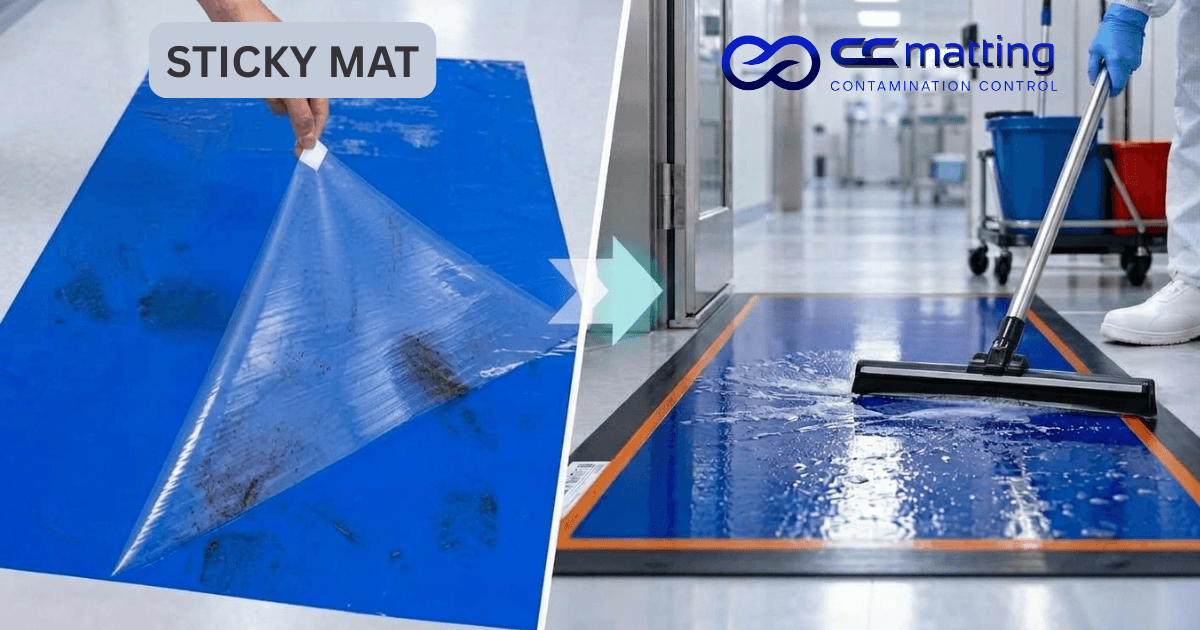
For teams evaluating a tacky mat alternative, the shift is from replenishment to cleaning. Sticky (Tacky) Mats
- Routine Task: Peel off and discard the top sheet. - SOP Documentation: Consumables replenishment. - Equipment Required: Replacement adhesive pads. - Waste Generated: Used adhesive sheets. - Service Life: Single-use sheets requiring regular replacement. Polymeric Contamination Control Mats - Routine Task: Wet-clean in place during routine floor cleaning. - SOP Documentation: Integrated into existing floor cleaning and disinfection SOPs. - Equipment Required: Existing mops, squeegees and wipers. - Waste Generated: Used cleaning solution and wipers. - Service Life: 3–5 years (manufacturer TDS).
Both need a written procedure. The difference is whether it lives in a reorder process or in the floor cleaning programme.
Why Cleaning Is Part of How Contamination Control Polymeric Matting Works
A polymeric mat removes particles from soles and wheels through repeated contact, and holds them until cleaned off. The mat is both capture point and reservoir; the SOP stops the reservoir becoming a source.
The evidence reflects this. In an independent walk-off study by CPC Laboratories, the CCM Heavy Duty Polymeric Mat was wiped with 70% isopropyl alcohol before testing, then removed over 90% of particles and fibres in every size category tested, from both shoe soles and trolley wheels. The laboratory states the results apply only to its test conditions, which is why site cleaning practice governs in-use performance.
The Cleaning SOP for Washable Cleanroom Mats
Before you start: materials and compatibility
Most sites already hold everything needed: mild neutral detergent, approved disinfectant, 70% IPA, lint-free wipers, a cleanroom mop and a non-abrasive squeegee.
The material safety data sheet lists acetones and abrasive agents as materials to avoid, and the technical data sheet gives a 0–80 °C heat resistance range. Disinfectant brands are not specified, so confirm your disinfectant and sporicide rotation with CC Matting before go-live.
Step 1: Remove loose debris dry
Lift debris with a dry wiper or HEPA-filtered vacuum. Dry sweeping resuspends particles beside the door you are protecting.
Step 2: Wash from the clean side to the dirty side
With a two-bucket mop, work detergent from the controlled-side edge towards the uncontrolled side, so loosened soil moves away from the cleaner zone.
Step 3: Squeegee towards the uncontrolled side
Use overlapping, single-direction strokes and collect the solution rather than leaving it at the edges. Pendulum testing to BS EN 16165:2021 classified the mat as low slip risk when wet (mean 57 PTV), but follow site wet-floor signage throughout.
Step 4: Disinfect according to your rotation
EU GMP Annex 1 expects cleaning before disinfection, and more than one disinfecting agent in the programme, including periodic sporicidal use. Observe validated contact times. The mat’s integrated antimicrobial additive, tested to ISO 22196, complements this step; it does not replace it.
Step 5: Remove residues and dry
Wipe with 70% IPA, or rinse as the disinfectant label directs, so residues do not build into a film. Allow to dry before traffic resumes.
Step 6: Inspect and record
Check edges and the floor junction for lifting or trapped residue, then log the clean alongside the surrounding contamination control flooring.
Set Frequency by Traffic, Not by Calendar
A goods-in trolley route loads a mat far faster than a quiet laboratory door, and cleanroom entrance mats at gowning thresholds carry much of the footwear contamination control burden. Base frequency on area grade, traffic and visible soiling, then review it against environmental monitoring. If counts near an entry point drift upwards, mat cleaning frequency is an early variable to check.
Make It One Line in an Existing SOP
List the mat as a named surface, with its own frequency, in your existing floor cleaning SOP. That keeps training, audit trails and change control simple.
Whichever contamination control mat supplier or contamination control mat distributor you use, ask for written chemical compatibility guidance and the test file. For teams specifying ISO Class 5 mats, CC Matting’s material carries a Fraunhofer IPA certificate rating it suitable for ISO Class 5. The mat supports a contamination control strategy; it does not demonstrate compliance on its own.
Frequently Asked Questions
Can polymeric cleanroom mats be cleaned with a standard squeegee and mop?
Yes. Polymeric contamination control mats are wet-cleaned in place like the surrounding floor, with a mop, mild detergent and a non-abrasive squeegee. No specialist machinery is needed, but the method belongs in your site SOP.
Which cleaning chemicals should be avoided on polymeric matting?
CC Matting’s safety data sheet lists acetones and abrasive agents as materials to avoid. Confirm disinfectant and sporicide compatibility with the manufacturer before adding them to your rotation, and keep cleaning temperatures within the documented 0–80 °C range.
Do antimicrobial cleanroom mats still need disinfecting?
Yes. An antimicrobial additive does not replace a documented disinfection programme. Pharmaceutical contamination control mats and healthcare contamination control mats should follow the same rotation as the surrounding floor.
How often should cleanroom entrance mats be cleaned?
There is no universal frequency. Trolley routes generally need cleaning more often than personnel-only doors; set and review frequency against area grade and environmental monitoring data.
How long do reusable contamination control mats last?
CC Matting’s technical data sheet gives a 3–5 year lifetime for its heavy-duty polymeric matting, with a two-year warranty. Actual life depends on traffic, load and compatible cleaning.
Next Step
If you are mapping contamination control matting into an existing cleaning programme, review the reusable contamination control matting specification, see the test documentation on the CC Matting compliance page, or ask the team for chemical compatibility guidance for your disinfectant rotation.