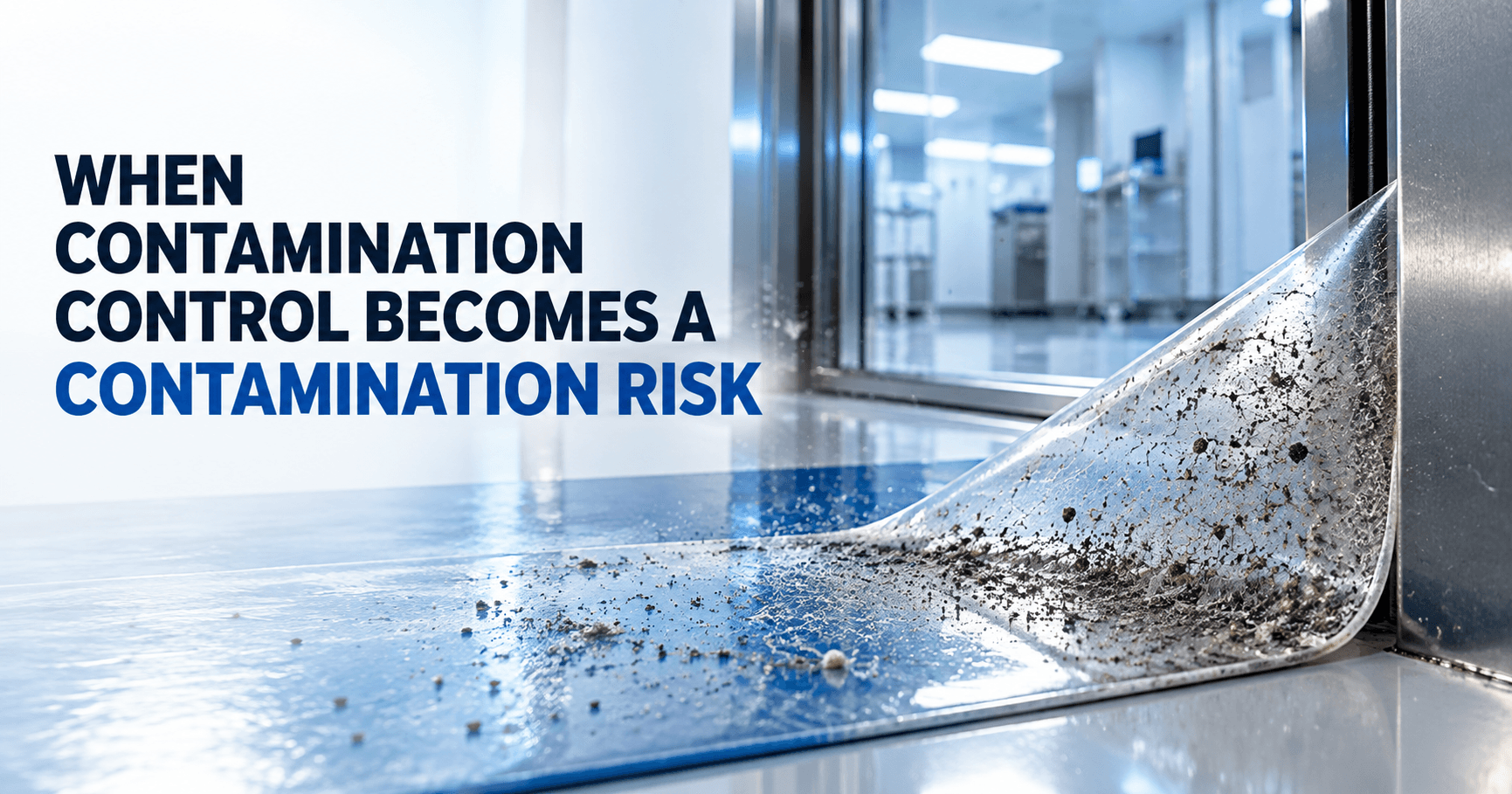
Watch a sticky mat being changed at a gowning-room door. An operator lifts a corner, draws the used sheet back on itself and folds it towards the bin. For a few seconds, a layer that has spent hours collecting floor debris is flexed and carried at knee height, on the clean side of the threshold.
That moment exposes the format's central weakness. A disposable sticky mat is a passive adhesive film, so its contribution to footwear contamination control depends on how loaded the sheet is, how it is removed, and whether its adhesive stays on the mat. Below are the mechanisms, and what a sticky mat alternative must do differently.
Sticky Mats vs Reusable Cleanroom Matting: Quick Comparison
1. Particle Capture Mechanism
Sticky Mats: Pressure-sensitive adhesive film retains particulates.
Polymeric Mats: Engineered polymeric surface captures particulates from footwear and equipment wheels.
2. Performance Consistency
Sticky Mats: Capture efficiency declines as adhesive surfaces become saturated.
Polymeric Mats: Performance is maintained through routine cleaning in accordance with site SOPs.
3. Maintenance Requirements
Sticky Mats: Require regular removal and replacement of contaminated sheets.
Polymeric Mats: Cleaned in place without removing surface layers.
4. Adhesive Residue
Sticky Mats: Potential adhesive transfer onto footwear and wheels.
Polymeric Mats: Adhesive-free construction eliminates peel-off adhesive residue.
5. Wheeled Traffic Compatibility
Sticky Mats: Sheet edges may lift, wrinkle or tear under trolley traffic.
Polymeric Mats: Independently tested for particulate removal from trolley wheels.
6. Waste & Service Life
Sticky Mats: Generate disposable sheet waste with every replacement.
Polymeric Mats: Washable, reusable construction with a documented 3–5-year service life for CC Matting.
Failure 1: Peeling Releases What the Sheet Collected
Adhesive holds a particle only where the particle touches glue. Once the surface is loaded, new debris increasingly rests on other particles and fibres rather than on adhesive, held weakly if at all.
Peeling bends and folds that loaded layer and moves air around it, so loosely held debris can detach or become airborne near the doorway. Separating adhesive films also generates static charge, a well-documented effect of tape peeling, which can draw particles towards gowns and gloves. The control is only as consistent as the person changing it.
Failure 2: Saturation Sets a Hidden Capacity Limit
Every captured particle occupies adhesive that cannot capture again, so performance is highest just after a peel and declines until the next one. Footfall concentrates on the stride line, meaning the centre can be saturated while the edges still look fresh.
Most sites peel on a schedule rather than on load. Shift changes and deliveries load a sheet far faster than a quiet afternoon, yet the interval rarely flexes to match, so performance varies across the day unmeasured.
Failure 3: Adhesive Transfer onto Shoes and Wheels
Pressure-sensitive adhesives can transfer under pressure and shear, exactly what heel strike, pivoting and braking trolleys apply. Residue on a sole becomes a small sticky surface that collects debris after the mat and deposits it further inside. Trolleys can also leave tacky tracks on the contamination control flooring beyond the threshold.
Why Variability Matters Under EU GMP Annex 1
The 2022 revision of EU GMP Annex 1 requires sterile manufacturers to maintain a documented contamination control strategy. Matting can sit within it, but no mat confers compliance alone, and a barrier that varies with peel timing and technique is harder to justify.
What to Use Instead: Washable Cleanroom Mats Built to Be Cleaned, Not Replaced
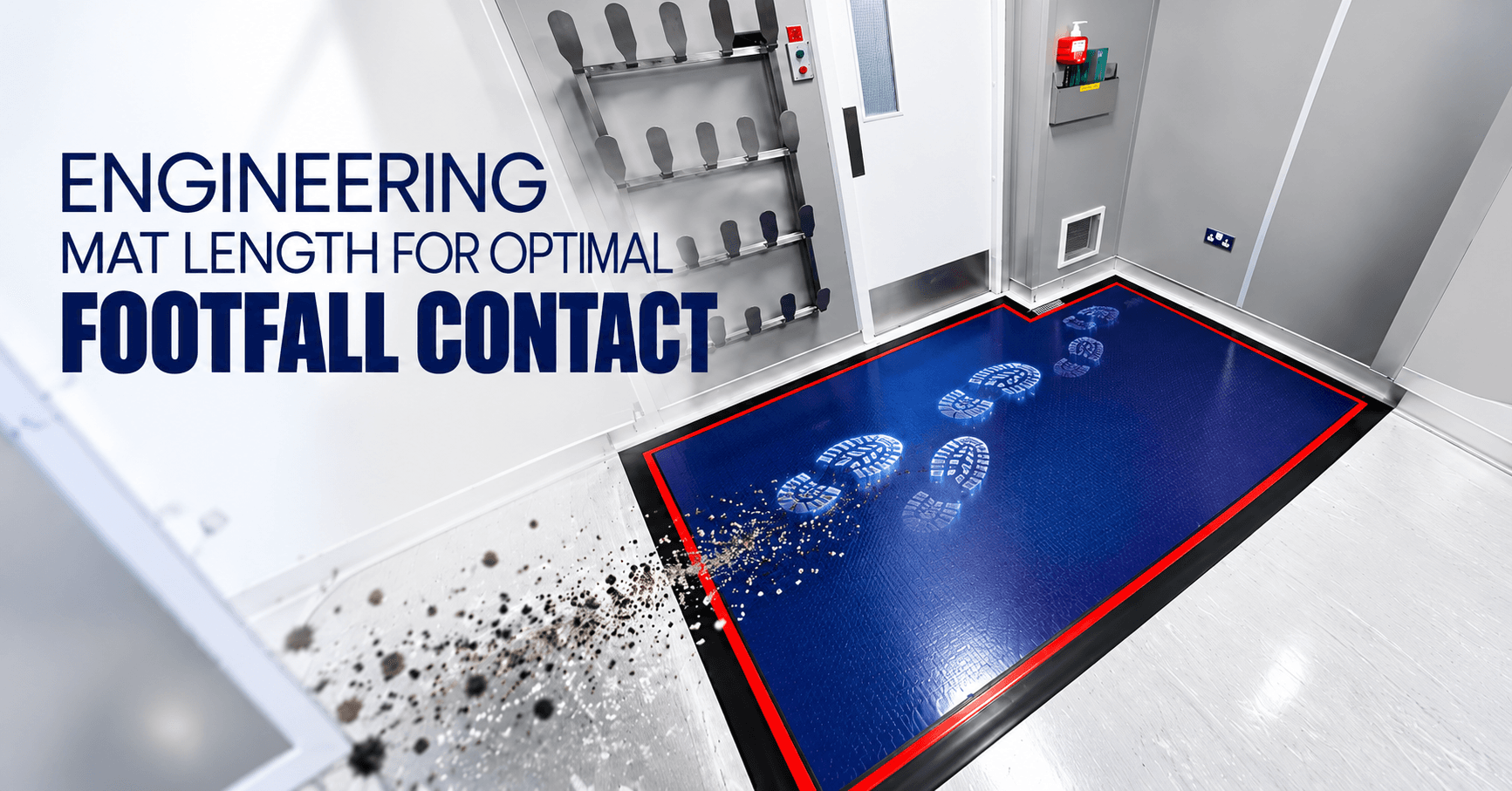
Contamination control polymeric matting changes the maintenance model: the surface is cleaned in place, so there is no loaded layer to peel and no adhesive film to transfer. When assessing washable contamination control mats from any contamination control mat supplier, ask for:
• Independent capture data for both footwear and wheels
• Particle emission data for the mat material itself
• Outgassing, static dissipation and wet slip results
• Approved cleaning agents and procedure
What That Evidence Looks Like
CC Matting's Quality & Efficacy Manual is one example. In a CPC Laboratories walk-off study using warehouse floor debris, three steps on the mat removed on average 91.8% of particles above 5 µm, 100% above 100 µm and 92.0% of fibres above 100 µm from shoe soles; trolley wheels rolled across 90 cm showed 90.1%, 100% and 100%. The laboratory notes that results apply to the study's materials and method.
The material also holds a Fraunhofer IPA certificate as suitable for ISO Class 5 air cleanliness, based on its own particle emission, and meets ASTM E595 outgassing screening levels at 50 °C. The full test certificates are published.
Frequently Asked Questions
Do sticky mats still work in cleanrooms?
They capture some particulate. The limitation is consistency: capture falls as adhesive loads, peeling disturbs collected debris, and residue can transfer to soles and wheels.
How often should sticky mats be peeled?
There is no universal interval. Frequency should reflect real traffic, including peaks such as shift changes, and be supported by site data such as loading checks or environmental monitoring trends.
What does "ISO Class 5" mean for cleanroom mats?
For ISO Class 5 mats, the rating usually describes the material's own particle emission, assessed against ISO 14644-1 limits. It does not measure how much contamination the mat removes, and it does not classify the room.
How are washable contamination control mats cleaned?
Follow the manufacturer's instructions and your SOP. In CC Matting's efficacy testing, the mat was cleaned with 70% isopropyl alcohol and lint-free wipers; its safety data sheet advises avoiding acetones and abrasive agents.
Will a contamination control mat make my facility Annex 1 compliant?
No single product delivers compliance. Under Annex 1, matting is one control within a contamination control strategy that also covers gowning, airflow, cleaning and material transfer.
Where to Go Next
If you are reviewing cleanroom entrance mats, start by mapping where foot and wheel traffic crosses into higher-grade areas. Specifications for reusable contamination control matting are on the product page, with sector detail for pharmaceutical contamination control mats and healthcare contamination control mats. CC Matting installs in Ireland and the UK; elsewhere, enquire via a contamination control mat distributor or contact the team.