give me ctaegory and tags for this blog also create a non generic image
Isolator users know the "ring of concern": where the alpha port on the isolator wall meets the beta flange of a mobile container. Both parts can be clean, yet the join is where contamination gets in.
Cleanroom doorways behave the same way. A room can have cleanroom entrance mats down and still find floor-borne particles on the clean side. Borrowing the alpha/beta language as a working framework (not a regulatory term), those leaks fall into two kinds:
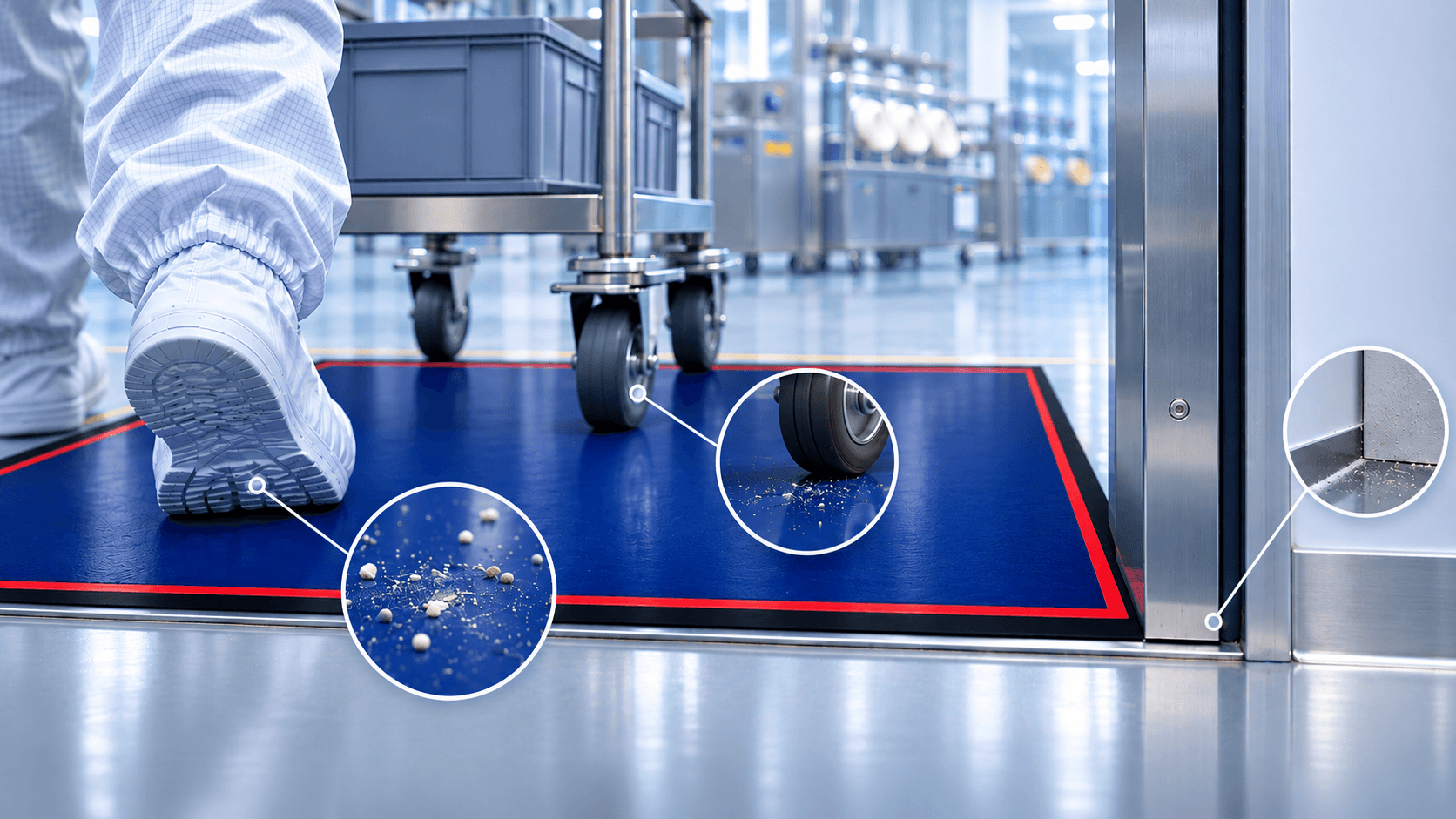
• The beta gap: contamination still carried by whatever moves across the threshold, such as soles, trolley wheels and pallet trucks.
• The alpha gap: weaknesses in the fixed side of the threshold: the installation, the floor around it and how it is maintained.
The Beta Gap: What Footwear and Wheels Still Carry
Contact count is the controlling variable
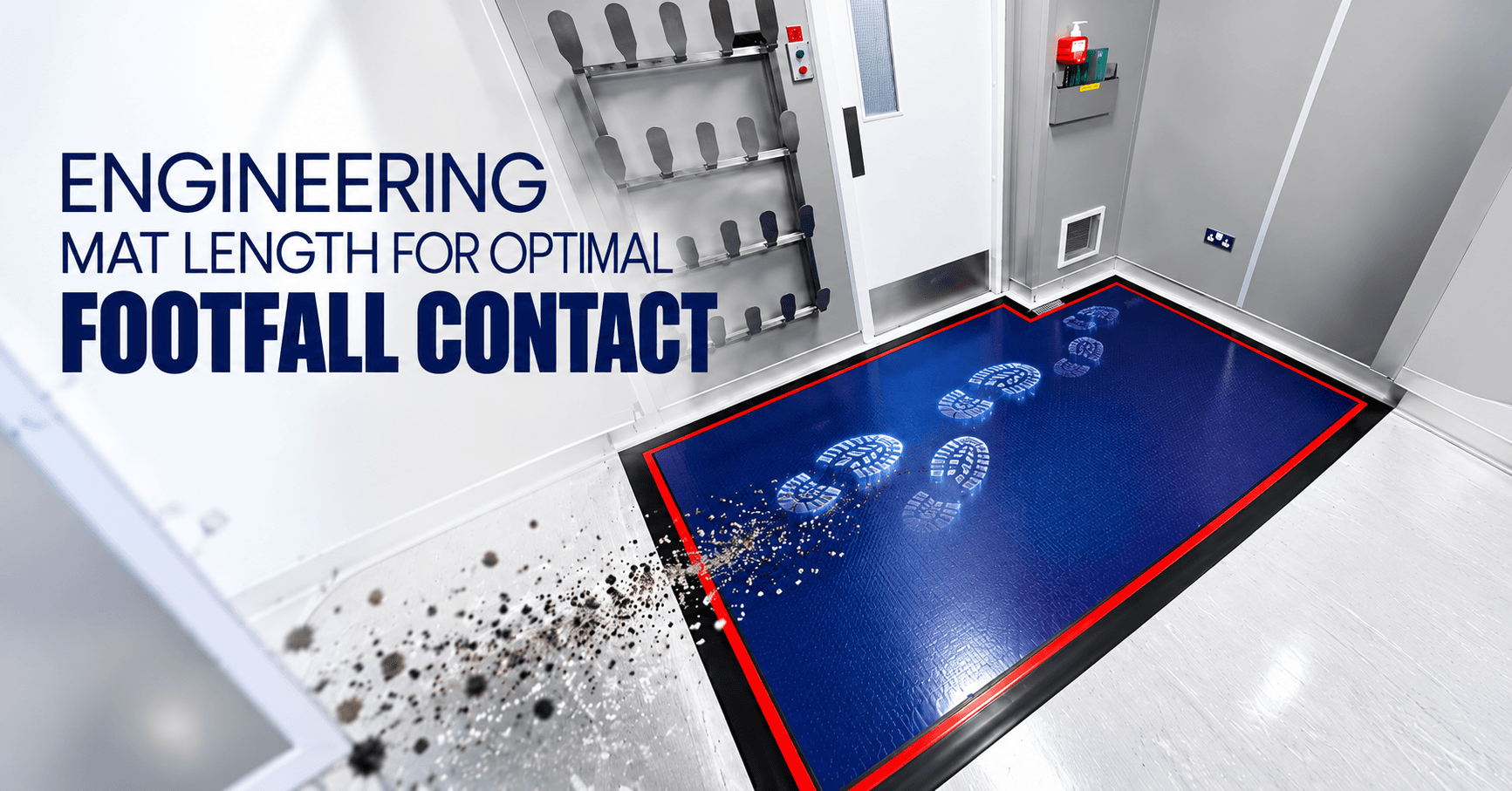
A sole or tread only releases particles where it touches the capture surface. One stride onto a short mat gives each foot a single contact; a trolley clipping a corner presents only part of its wheel.
Test protocols reflect this. In independent walk-off testing by CPC Laboratories (February 2026), CC Matting's heavy-duty polymeric mat was challenged with warehouse floor dirt. With three steps per shoe, average removal was 91.8% for particles above 5 µm, 100% above 100 µm and 92.0% for fibres above 100 µm. Trolley wheels rolled across 90 cm of mat showed 90.1%, 100% and 100%.
The laboratory states these results apply only to its own method. The lesson is that performance was measured against defined steps and rolling length; a mat sized for fewer contacts should not be expected to match it.
The fine fraction persists
Coarse particles were removed completely; residual counts sat in the finer category, which is also the fraction most easily resuspended.
Closing the beta gap
• Size mats along the direction of travel so each foot makes several full contacts.
• Route trolleys so wheels roll the full mat length rather than crossing an edge.
• Treat footwear contamination control as a sequence: dedicated footwear or overshoes reduce the load before the mat sees it.
The Alpha Gap: Where Contamination Control Polymeric Matting Meets the Building
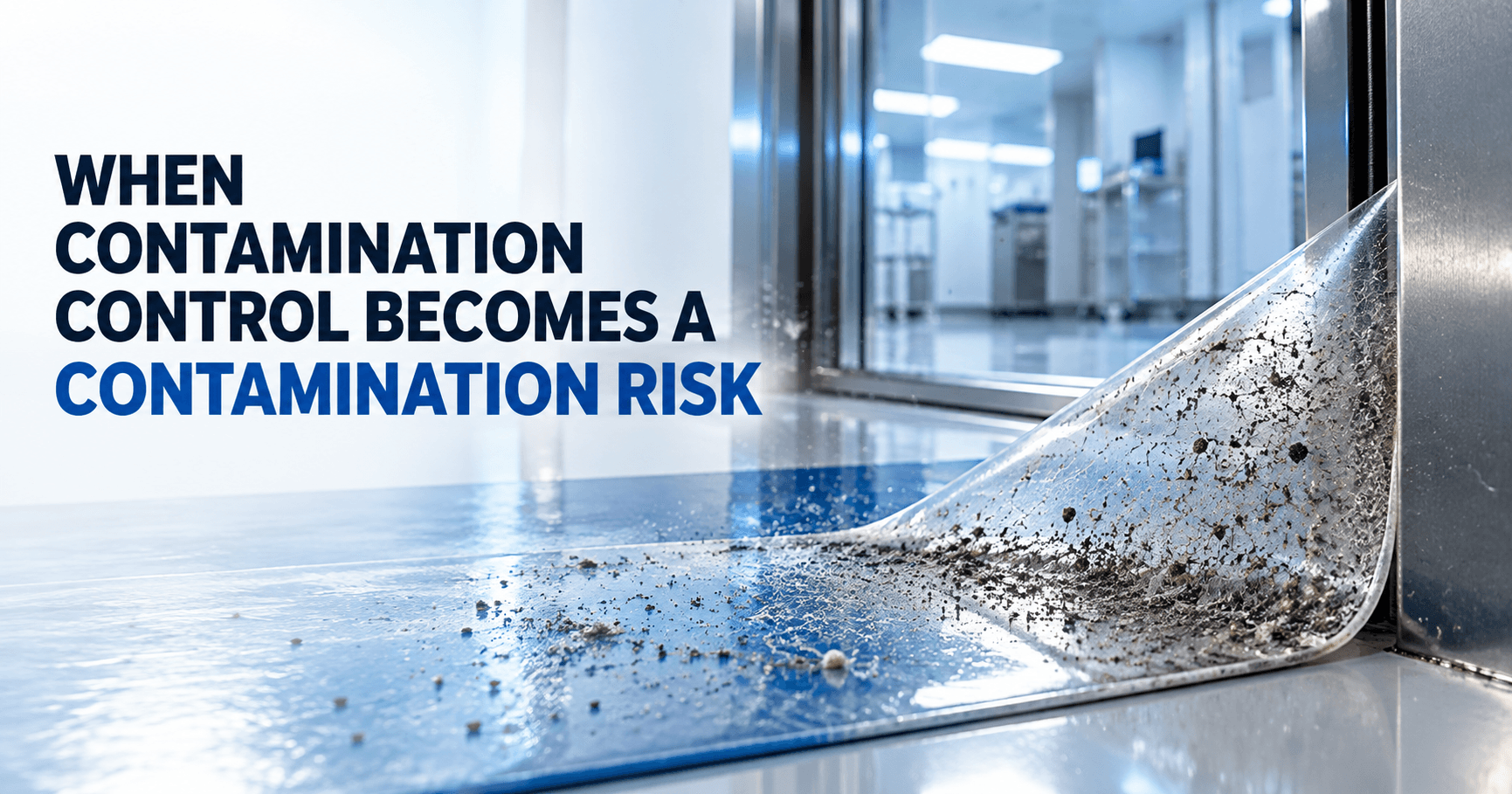
Seams, edges and bare strips
Joints, lifted edges and bare floor at the door frame collect material outside the capture surface. Wide-format contamination control flooring reduces joins: CC Matting's heavy-duty material is supplied at 2.0 m width with no length limit, so most single doorways need no seam.
The mat as a particle source
A walked surface is under constant friction. Fraunhofer IPA tested CC Matting's material under tribological stress (reel-on-disc, 300 N) and certified its particle emission as suitable for ISO Class 5 air cleanliness. That is what ISO Class 5 mats should mean: evidence about what the material emits, not a guarantee about the room.
Where a sticky mat alternative changes the alpha gap
Peel-off tacky mats rely on peel discipline: each layer has finite capacity, and renewal is a manual step at the threshold. Reusable polymeric contamination control mats move that dependency to cleaning. Neither removes the need for a procedure.
- Surface Renewal
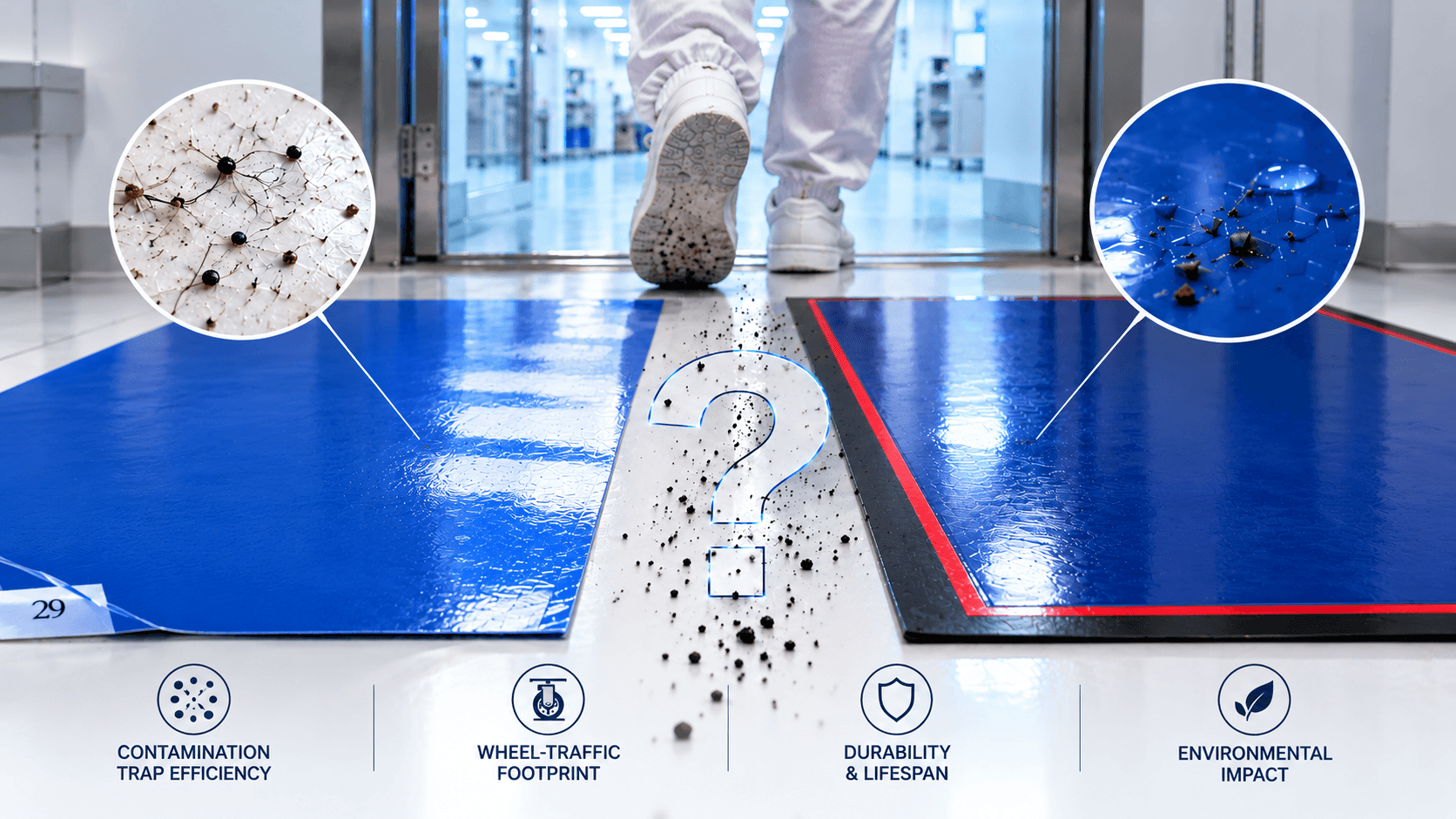
Peel-off tacky/sticky mat: Peel and discard the top sheet.
Reusable polymeric mat: Clean in place.
- Performance Depends On
Peel-off tacky/sticky mat: Peel frequency and compliance.
Reusable polymeric mat: Cleaning frequency and method.
- Threshold Activity
Peel-off tacky/sticky mat: Removing a loaded sheet.
Reusable polymeric mat: Wet wiping, e.g., with 70% IPA.
- Replacement
Peel-off tacky/sticky mat: Sheets discarded routinely.
Reusable polymeric mat: Stated service life of 3–5 years.
- Fit to Doorway
Peel-off tacky/sticky mat: Fixed sheet sizes.
Reusable polymeric mat: Up to 2.0 m wide and cut to any required length.
Washable cleanroom mats only work if they are washed
In the CPC study the mat was prepared with 70% isopropyl alcohol and lint-free wipers; the safety data sheet lists acetones and abrasive agents to avoid. Because cleaning is wet, slip matters: pendulum testing to BS EN 16165 recorded 57 PTV wet, classed as low slip risk.
Mapping Both Gaps in a Reusable Cleanroom Matting Strategy
EU GMP Annex 1 (2022) expects a documented, facility-wide contamination control strategy. Matting supports it; it does not deliver compliance on its own. At each threshold, ask:
• Beta: how many full contacts does each foot and wheel get, and could the load be reduced upstream?
• Alpha: is there any seam, lifted edge or bare floor in the walkway, and who cleans the mat, how often, with what record?
This applies equally to pharmaceutical contamination control mats, healthcare contamination control mats and static-dissipative matting at data centres.
Frequently Asked Questions
What is the alpha gap in cleanroom contamination control?
A working term for contamination passing through the fixed part of a threshold: seams, uncovered floor, lifted edges, particles shed by the mat or lapses in cleaning. The beta gap is contamination still carried on moving soles and wheels.
How many steps should a cleanroom entrance mat allow?
Enough for several full contacts per foot. Published walk-off results are tied to a defined number of steps, so check the protocol behind any figure and size the mat to match it.
Is a polymeric mat a suitable tacky mat alternative in GMP areas?
It can be, provided its use is defined in your contamination control strategy with cleaning frequency, approved agents and records, and selection is based on test evidence for particle removal and emission.
What does "ISO Class 5" mean for cleanroom mats?
Typically that the material's particle emission under mechanical stress was tested and found within ISO 14644-1 Class 5 limits. It describes the material, not the room.
How should washable contamination control mats be cleaned?
Follow approved agents and frequency. For CC Matting's heavy-duty mat, 70% isopropyl alcohol with lint-free wipers was used in testing; avoid acetones and abrasives.
Next Step
The test reports cited here are compiled in CC Matting's Quality & Efficacy Manual, with specifications for reusable contamination control matting on the product page. CC Matting installs in Ireland and the UK and acts as a contamination control mat supplier and distributor worldwide; you can request a site survey to map both gaps at your doorways.