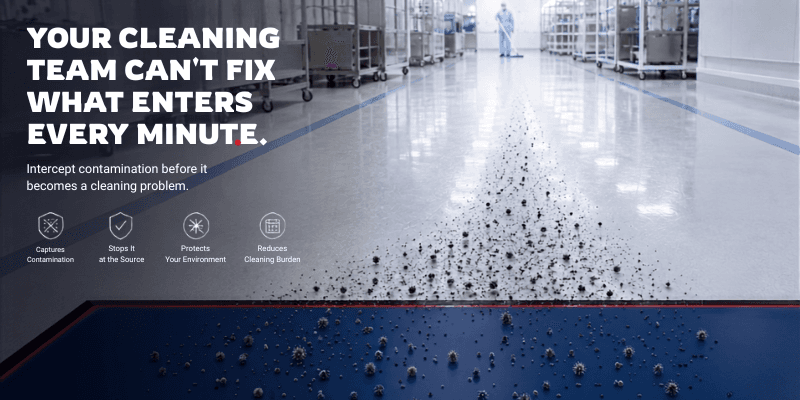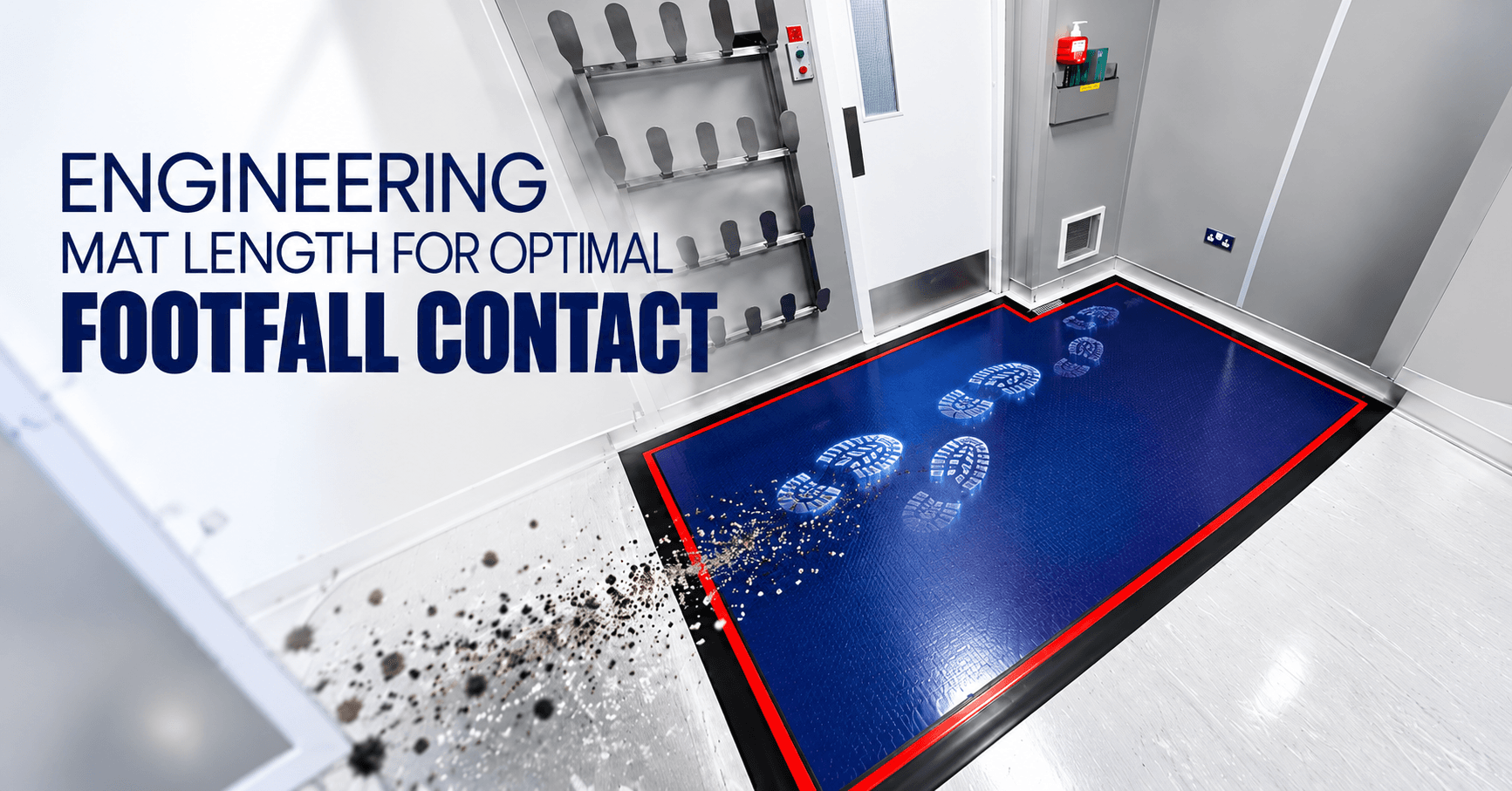
Ask how a site's cleanroom entrance mats were specified and the answer is usually a door width. Few can say how many times each shoe touches the capture surface before crossing into a cleaner zone. Yet contacts per foot is what decides how much floor-borne particulate gets left behind.
This guide treats placement as a geometry problem, and shows why a short peel-off pad rarely delivers the contact count the evidence assumes.
Quick answer: what makes walk-off matting work?
Three things: how many times each sole and wheel contacts the capture surface, whether that surface is clean enough to keep capturing, and whether the mat sits exactly where traffic crosses a cleanliness boundary. Size the run by footfalls, not door width.
1. Peel-Off Sticky Mats
Typical Footprint: Pre-cut sheets, generally 90–115 cm long.
Foot Contact: Often one contact per foot, sometimes none.
Surface Renewal: Contaminated top layer peeled off and discarded.
Service Life: Single-use adhesive layers.
2. Reusable Polymeric Contamination Control Matting
Typical Footprint: 2.0 m wide, with customisable run lengths.
Foot Contact: Multiple contacts depending on installed mat length.
Surface Renewal: Cleaned in place without layer replacement.
Service Life: 3–5 years (CC Matting data sheet).
The arithmetic of a footfall
A typical adult walking step is roughly 0.6–0.8 m, and footfalls alternate. On a 90 cm sheet, someone walking normally lands about one footfall: one shoe gets a single contact, the other may miss entirely. Transfer is cumulative: each contact strips part of the load on a sole, so one contact leaves more behind than several.
What the evidence is based on
In an independent walk-off study by CPC Laboratories (February 2026), a shoe loaded with warehouse floor dirt took three steps on a CC Matting heavy-duty polymeric mat. Average removal was 91.8% for particles over 5 µm, 100% for particles over 100 µm and 92.0% for fibres over 100 µm. Trolley wheels rolled across 90 cm of mat showed 90.1%, 100% and 100%.
The laboratory states these results apply only to the conditions tested. The planning takeaway is the condition itself: three contacts per shoe, and a 90 cm wheel run.
Turning contacts into metres
Three contacts per foot means six footfalls. At a 0.7 m step the sixth lands about 3.5 m from the first, so allow roughly 3.5–4 m for walking traffic. Slower, shorter steps in airlocks may need less length, so observe your own traffic before fixing a dimension.

Figure 1. Walk-off length: contacts per foot on a short sheet versus a run sized for three contacts per foot.
Placing polymeric contamination control mats at each boundary
The uncontrolled-to-controlled entrance
The first interface carries the heaviest load. Run contamination control matting wall to wall so nobody steps around it, and start it before the door so the first contact happens on the dirty side. A 2.0 m width covers most corridor doors without a seam.
Personnel airlocks and gowning rooms
Here, pharmaceutical and healthcare contamination control mats support, rather than replace, footwear contamination control such as shoe changes and step-over benches. Mat the approach to the bench, consider a second run where cleanroom footwear first meets the floor, and cover the spot where people wait at interlocked doors.
Airlocks are wet-cleaned often, so slip resistance matters. CC Matting material was tested to BS EN 16165 with pendulum values of 65 (dry) and 57 (wet), classed as low slip risk.
Material airlocks and trolley routes
Wheels need distance, not steps. Align the run with the actual wheel path, including turning points toward a pass-through, so each wheel makes at least one full traverse of the tested 90 cm length.
Washable cleanroom mats as one control, not the control
EU GMP Annex 1 (2022) expects a site-wide Contamination Control Strategy covering personnel, material and equipment flows. It does not prescribe mats, and no mat confers compliance. Matting works alongside cleaning, gowning discipline, transfer procedures and monitoring data.
Material choice matters too, because cleanroom mats become part of the contamination control flooring. For buyers searching for ISO Class 5 mats, ask what was tested: CC Matting's material holds a Fraunhofer IPA qualification as suitable for ISO Class 5 air cleanliness, based on particle emission under mechanical stress. It is also static dissipative, relevant to semiconductor and data centre floors.
For teams looking for a tacky mat alternative, the real change is often re-specifying the run length the original pads never had.
FAQs
How long should a cleanroom entrance mat be?
Long enough for each shoe to land on it several times. Planning for three contacts per foot at a 0.7 m step gives roughly 3.5–4 m.
Is a sticky mat alternative needed for airlocks?
Not automatically. Most pre-cut sticky mat sheets are around a metre long, so a person at normal pace may land only one footfall. Whether that is acceptable depends on your risk assessment and the contact count you need.
Where should contamination control mats go in a material airlock?
Along the wheel path, covering the full approach to the pass-through or door, including turning points, so each wheel makes a full traverse rather than clipping a corner.
How are washable contamination control mats cleaned?
CC Matting's walk-off study prepared the mat with 70% isopropyl alcohol and cleanroom wipers. The safety data sheet advises avoiding acetones and abrasive agents. Set frequency in your own SOP based on traffic and monitoring.
Does contamination control matting make a facility Annex 1 compliant?
No. Annex 1 requires a documented Contamination Control Strategy. Matting can be one justified control for personnel and material movement, but compliance depends on the whole system and its monitoring.
Next step
The test reports behind each figure above are on the CC Matting compliance page, and specifications are on the reusable contamination control matting page. As a contamination control mat supplier installing in Ireland and the UK, the team can review your airlock layout, or connect you with a contamination control mat distributor elsewhere.