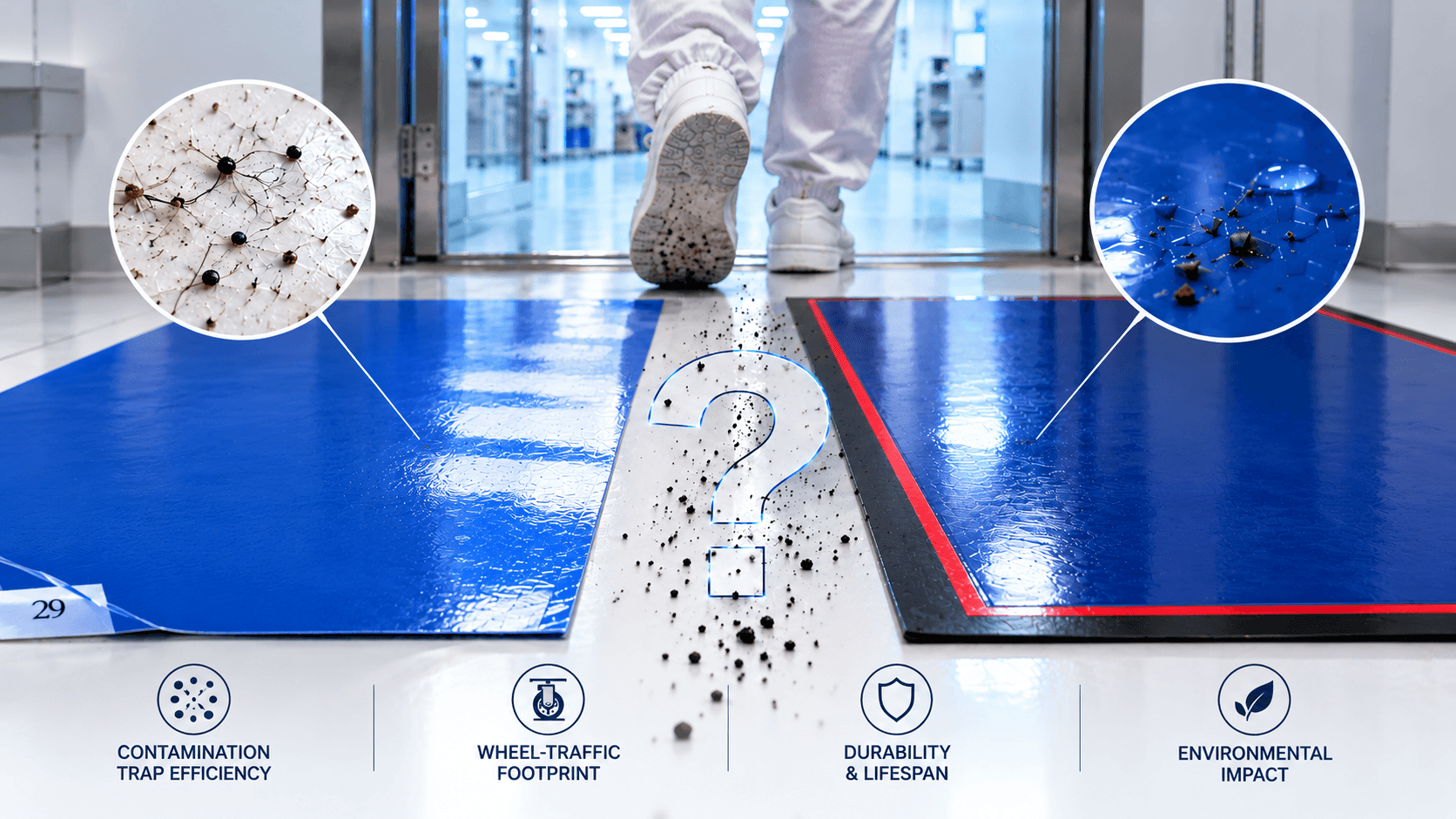
Washable Cleanroom Mats: How Polymeric Contamination Control Matting Works
Quick answer: Washable cleanroom mats made from polymeric contamination control matting are a reusable polymer floor covering that holds particles from shoes and trolley wheels until it is cleaned. CC Matting's matting is 2.0 m wide, cut to length and has a 3–5 year lifetime. In
independent testing, it removed over 90% of particles larger than 5 µm from
soles and wheels.
This guide explains how polymeric contamination control matting captures particles, how to
size it for footwear and trolley traffic, and how durable it is. It also sets
out the independent test evidence behind CC Matting's matting and where it is
typically used.
How Polymeric Matting Captures Particles: Contact Count Matters
A mat only removes contamination that touches it. Real-world performance depends on two things: how well the surface holds particles, and how many full contacts each sole or wheel makes on the way through.
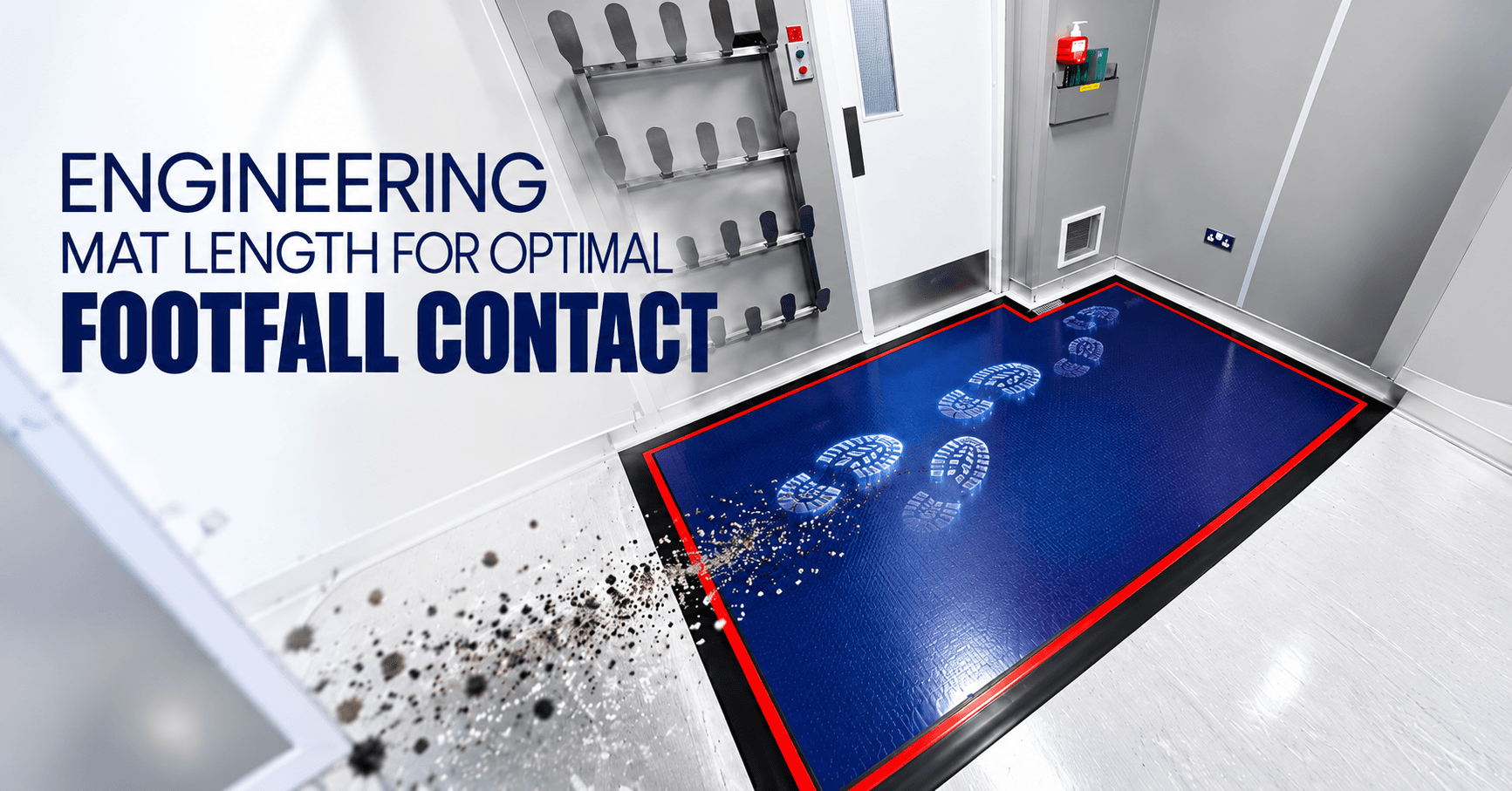
With an adult stride of roughly 70 cm, a short mat may receive only one contact per foot. A longer run gives each shoe several contacts, so more of the sole meets the surface before it reaches the cleaner zone. Captured particles stay on the polymer surface until the mat is cleaned under your SOP.
Footprint and Wheel Traffic: Sizing Washable Cleanroom Mats
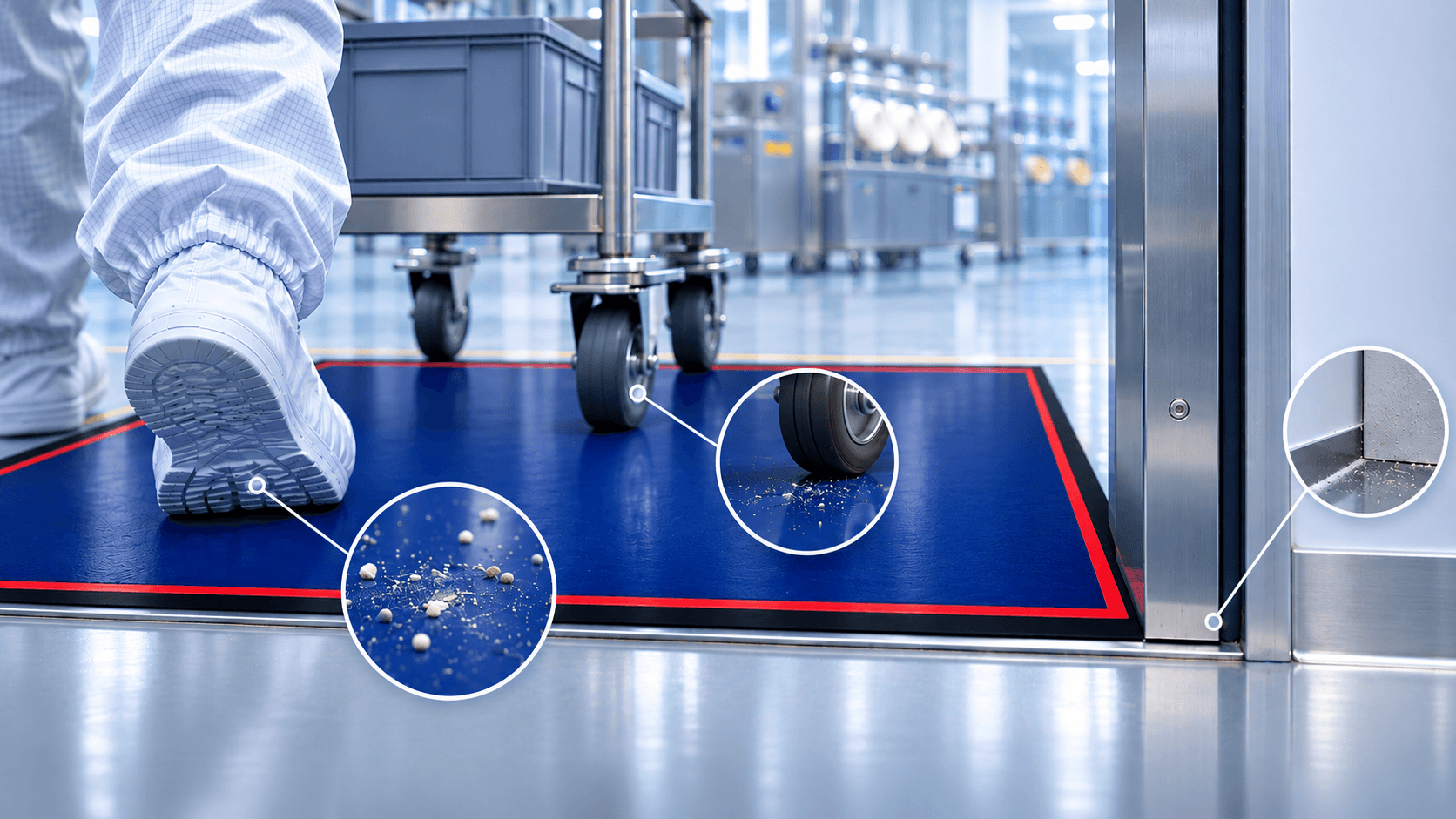
Footwear is only half the picture. A trolley wheel only cleans the part of its circumference that rolls across the mat, and rear wheels arrive last.
A practical rule is mat length ≥ wheelbase + two wheel circumferences. A 125 mm wheel has a circumference of about 39 cm, so a trolley with an 80 cm wheelbase needs roughly 1.6 m.
Because CC Matting's polymeric matting is 2.0 m wide and cut to length, it can run wall to wall at a transition, working more like contamination control flooring than a doormat. For placement by zone and traffic type, see how to size matting by walk-off length.
How Durable Are Washable Cleanroom Mats?
CC Matting's reusable cleanroom mats are designed to be cleaned and reused throughout their service life. The technical data sheet specifies a 3–5 year lifetime with a full two-year warranty, and a load resistance of 130 kg/cm², which matters where trolleys and pallet trucks cross every day.
Durability also depends on care. The safety data sheet lists acetones and abrasive agents as
materials to avoid, so keep them out of your cleaning procedure.
Test Evidence for CC Matting Polymeric Matting
CC Matting's polymeric contamination control matting is supported by independent testing and manufacturer documentation. The full reports are available on the compliance page.
Particle removal: shoe soles
• Particles larger than 5 µm: 91.8% removed
• Particles larger than 100 µm: 100% removed
• Fibres larger than 100 µm: 92.0% removed
Particle removal: trolley wheels
• Particles larger than 5 µm: 90.1% removed
• Particles larger than 100 µm: 100% removed
• Fibres larger than 100 µm: 100% removed
Removal results apply to the materials and conditions tested, so site particle monitoring remains the real test.
Material, safety and durability properties
• Particle emission: Material qualified as suitable for ISO Class 5 environments. A material rating describes the mat, not the room.
• Outgassing: Total mass loss (TML) 0.29%; collected volatile condensable materials (CVCM) 0.08%.
• Antimicrobial activity: Integrated antimicrobial additive, tested to ISO 22196:2011. Antimicrobial results apply to the tested surface under laboratory conditions; the additive supports routine cleaning but does not replace it.
• Static control: Surface resistivity of 1×10¹⁰ Ω/sq, in the static-dissipative range. Confirm compatibility with your ESD programme and grounding.
• Slip resistance: Mean 65 PTV dry and 57 PTV wet, both in the low slip risk range.
• Load resistance: 130 kg/cm².
• Lifetime and warranty: 3–5 year lifetime, with a full two-year warranty.
Where Washable Polymeric Matting Is Used
Washable polymeric matting is installed at transitions where people, materials and wheels move from a less clean zone into a cleaner one, such as:
• Gowning-room entrances
• Grade C airlocks in pharmaceutical manufacturing
• Aseptic pharmacy and hospital compounding units
• Trolley and material routes between zones of different grades
EU GMP Annex 1 expects a documented contamination control strategy but does not prescribe a mat type. Record the rationale, placement, cleaning and monitoring for each mat; no mat, on its own, guarantees compliance. See how matting fits pharmaceutical manufacturing.
Searching for a Washable Sticky Mat?
Buyers often search for washable or reusable sticky mats when they want to stop replacing peel-off sheets. Polymeric contamination control matting is a different category: it is not made from peel-off adhesive sheets, and it is cleaned rather than peeled. See our total cost of ownership comparison, or read how to choose an alternative.
Frequently Asked Questions
How long do reusable cleanroom mats last?
CC Matting's polymeric contamination control matting has a specified lifetime of 3–5 years with a full two-year warranty. Actual life depends on traffic and care: avoid acetones and abrasive agents, which the product's safety data sheet lists as materials to avoid.
How effective are washable cleanroom mats?
Effectiveness depends on how well the surface holds particles and how many contacts each sole or wheel makes. In independent testing, CC Matting's polymeric matting removed 91.8% of particles above 5 µm from shoe soles and 90.1% from trolley wheels, and 100% of particles above 100 µm from both.
How long should a cleanroom mat be for trolley traffic?
Long enough for every wheel to rotate fully at least twice on it: the wheelbase plus two wheel circumferences. A trolley with an 80 cm wheelbase and 125 mm wheels needs roughly 1.6 m.
How often should polymeric contamination control mats be cleaned?
There is no universal interval. Set a starting frequency from traffic volume and the grade of the adjacent room, then adjust it using particle monitoring data.
Does EU GMP Annex 1 require contamination control mats?
No. Annex 1 requires a contamination control strategy covering all contamination sources, including personnel and material flow. Matting can be one justified, monitored control within it.
Can polymeric matting be used in ESD-sensitive areas?
CC Matting's polymeric matting has a surface resistivity of 1×10¹⁰ Ω/sq, in the static-dissipative range. Confirm compatibility with your site's ESD programme and grounding requirements before installation.
Next Step
Review the specification on the heavy-duty polymeric contamination control matting page, or the test reports on the compliance page. For temporary areas, ask about portable cleanroom mats. CC Matting installs in Ireland and the UK and distributes worldwide; contact the team to discuss sizing for your doors and trolley routes.